How we work: editorial standards
Editorial Standards
Our editorial standards set out how articles and service pages on vardhinivastu.com are written, checked and kept up to date.
Who writes the content
Every page on this site is written or reviewed by Raghavendra Hebbur, founder of Vardhini Vastu, Certified Geo Master and creator of the VIDS™ method, drawing on more than ten years of practice and over 3,200 consultations. He is also translating the Aparajitaprccha, a twelfth-century Sanskrit treatise on architecture, which is one of the classical texts we refer to.
How we separate evidence from tradition
Vastu is a traditional knowledge system. We say clearly which statements come from classical texts, which come from what we measure on site (compass degrees, Lecher Antenna readings), and which are our professional interpretation. Where articles use labels, they mean:
- Traditional: stated in classical Vastu texts.
- Measured: recorded with instruments at a property.
- Interpretive: our reasoned reading of how a principle applies today.
We do not claim that Vastu is a substitute for medical, legal, structural or financial advice, and we never use fear to sell a remedy.
No demolition, no upselling
Our published advice follows the same rule as our consultations: corrections must work without breaking walls. We do not sell yantras, pyramids, crystals or products, so no article is written to push one.
Updates and corrections
Each article shows when it was last updated. If you find an error, write to raghu.hebbur@gmail.com. We check every report and correct the page if needed.
Why we publish editorial standards
Much of what is written about Vastu online is copied from page to page, stripped of its source and often written to frighten. A reader has no way to tell whether a rule comes from a classical text, from someone measuring a real building, or from a sales script.
Publishing our editorial standards is a simple answer to that. It tells you how a page on this site was put together, what it can and cannot claim, and how to hold us to it.
How a page is researched and reviewed
Each article or service page starts from three kinds of material:
- Classical texts, including the Aparajitaprccha, the 12th-century Sanskrit treatise on architecture that Raghavendra Hebbur is translating.
- What we see and measure in practice across more than ten years and 3,200+ consultations, described in general terms without naming any client.
- Reliable public data where it applies, such as magnetic declination figures.
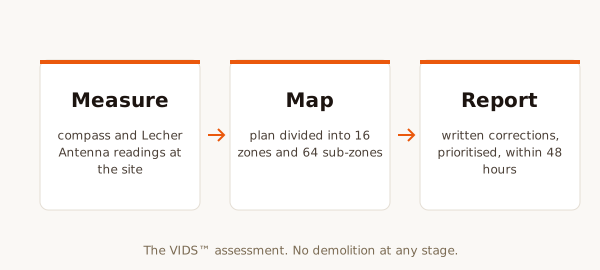
Drafts are checked against the VIDS™ methodology so that a page never recommends something the method itself would not.
How direction claims are written
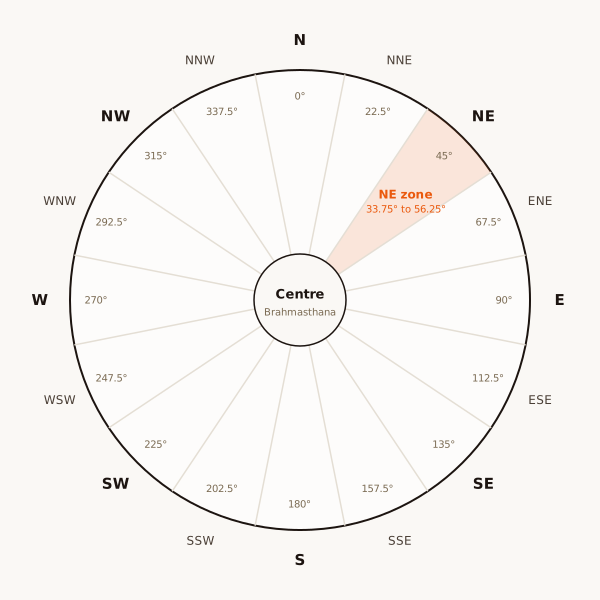
Vague phrases like “face the east” are avoided where precision matters. Our pages refer to the 16 zones of about 22.5 degrees each, measured from true north. Where a reader is asked to check a direction, we explain that a phone compass shows magnetic north and point to the NOAA magnetic declination calculator for the correction.
The 16 zones explained guide is the reference that other pages link back to, so the same zone always means the same thing across the site.
The three labels in practice
The labels described above work like this in a real article:
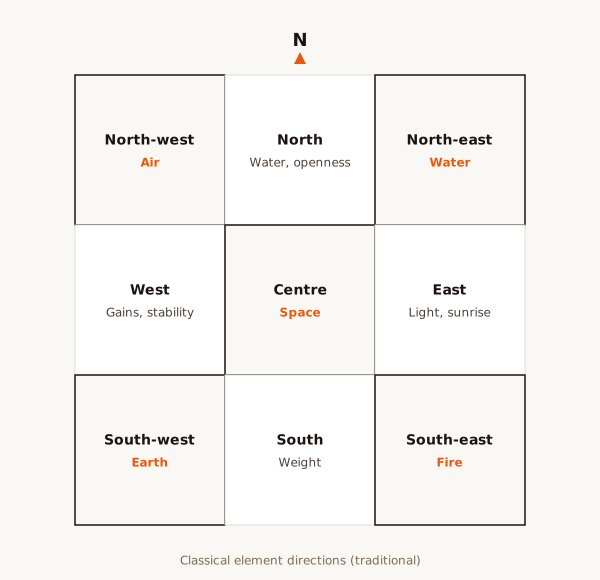
- Traditional: “Classical texts associate the north-east with water and openness.” This reports what the texts say, not a measured effect.
- Measured: “The main door was recorded at 74 degrees.” This is a reading taken at a property with an instrument.
- Interpretive: “In a flat where the north-east holds a toilet that cannot move, we suggest keeping the door closed and the area well lit.” This is our reasoned advice.
If a sentence mixes these, it is rewritten until each part is clear.
What we will not publish
- Claims that a Vastu change guarantees wealth, health, marriage or any other outcome.
- Fear-based warnings designed to push a reader into urgent action.
- Client names, photographs of identifiable homes or specific case results.
- Recommendations that depend on buying a product, since we sell none.
- Advice that requires demolition as the default answer.
A page that cannot meet these rules is not published.
Corrections must be practical
Advice on this site follows the same rule as our consultations: placement, colour, lighting, room use and decluttering come first. Where a page discusses an issue that genuinely needs construction, it says so plainly rather than hiding it. The zero-demolition corrections guide sets out the approach in detail.
Examples, samples and diagrams
Examples on the site are general descriptions, such as “a typical office we see”, and never refer to a real client. The sample Vastu report is labelled as illustrative and uses representative details.
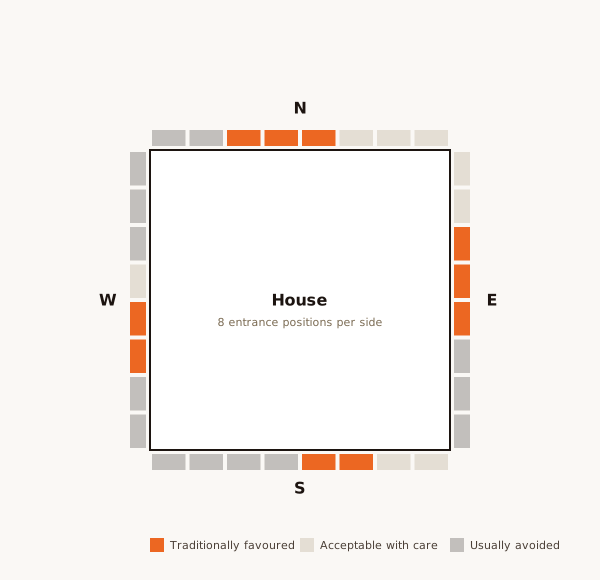
Diagrams are schematic. They show how zones and entrances relate to each other, not the plan of any particular building, and they are captioned so that a reader can tell what they show.
Independence and conflicts of interest
Vardhini Vastu sells no products and takes no commission from builders, interior firms or property sellers. No page on this site is written to promote a project or a product, and a recommendation about whether to buy a plot or a flat is never influenced by a third party.
Facts and fees kept consistent
Facts that appear on many pages, such as fees, the 48-hour report time and the length of a typical site visit, are kept in one place on the pricing page and checked whenever they change. If two pages disagree, the pricing page is the one to trust, and the other page is corrected.
Health, legal and structural topics
Vastu is not a substitute for a doctor, a lawyer, a structural engineer or a financial adviser. Where an article touches on sleep, safety, property title or building structure, it says that a qualified professional should be consulted, and it does not suggest otherwise.
Who applies these editorial standards
Raghavendra Hebbur, Certified Geo Master and founder of the practice, writes or reviews every page. You can read about his background on the about page. The same standards apply to written consultation reports, so what you read on the site and what you receive after a visit follow the same rules.
Plain language and explained terms
Pages are written in plain English with short paragraphs. Technical or Sanskrit terms, such as pada for a sub-zone or Brahmasthan for the centre of a building, are explained the first time they appear.
We avoid jargon that sounds impressive but tells the reader nothing. If a sentence cannot be understood by someone reading it on a phone between other tasks, it is rewritten.
How sources are named and linked
When a page relies on a classical text, it names the text instead of saying “the shastras say”. When it relies on public data, it links to the original source. External links go to credible, non-commercial sources and open in a new tab, so a reader can check the claim and come back.
Internal links point to the page that covers a topic in full, so the same explanation is not repeated in slightly different words across the site.
When advice here differs from elsewhere
You may read something on this site that contradicts another consultant, a relative or a popular video. That is normal in a traditional field. Because each claim here is labelled as traditional, measured or interpretive, you can see exactly where the difference lies and decide for yourself.
If you think we have got something wrong, we would rather hear it. The email address above reaches the person who wrote the page.
Keeping pages current
Each article shows the date it was last updated. Pages are reviewed when the method, the fees or the guidance on a topic changes, and the date is changed only when the content has changed in a way a reader would notice.
Older guidance that has been replaced is corrected on the page itself, so a reader arriving from a search engine sees the current advice rather than an outdated version.
How these editorial standards help you choose
A consultant who explains how they work gives you something to compare. Before booking anyone, it is worth asking the same questions we ask of our own pages: Is the direction measured or guessed? Is the advice ranked by importance? Does it rely on buying something? Is demolition offered as the first answer?
If the answers are clear, you can judge the advice on its merits. If you would like to see how this works in a consultation, the online versus on-site guide and the services page are good next steps.