| Property | 2-bedroom apartment, 9th floor, east Bangalore |
|---|---|
| Assessment | On-site, compass readings at 5 points, Lecher Antenna scan |
| Main door | Measured at 74° (East-north-east zone) |
| Reference | Magnetic north, readings averaged, outliers discarded |
| Concerns raised by client | Restless sleep in master bedroom; difficulty focusing while working from home |
Sample vastu report: what you receive
Sample Vastu Report
This sample vastu report is a shortened, redacted example of the written VIDS™ report every client receives within 48 hours. It shows the structure, the readings we record and how corrections are prioritised.
Please note
This is an illustrative sample prepared to show the report format. The property details below are representative and do not identify any client. Real reports are longer and specific to the measured property.
1. Property snapshot
2. Zone map summary
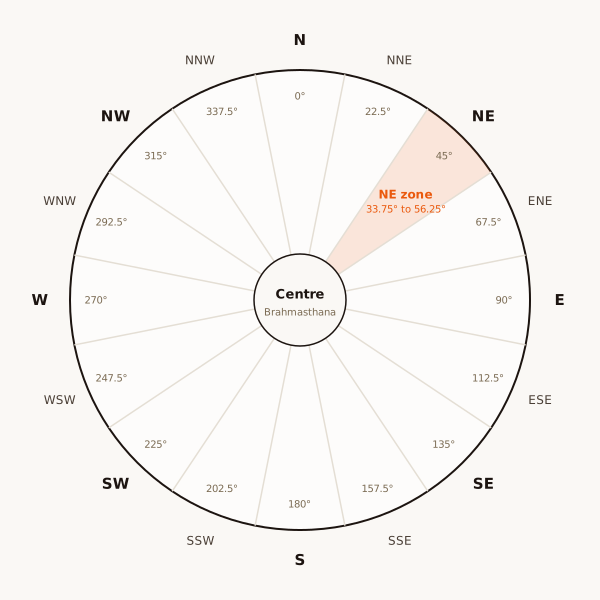
The flat was divided into 16 zones of 22.5° from its centre. Extract:
| Zone | Current use | Reading |
|---|---|---|
| North-east | Common toilet | Needs attention |
| East-north-east | Main entrance | Acceptable |
| South-east | Kitchen, stove facing east | Supportive |
| South-south-west | Master bedroom, bed head to north | Needs attention |
| West-north-west | Second bedroom used as study | Partly supportive |
| Centre | Dining table and storage unit | Cluttered |
3. Key observations
- The master bedroom sits in a stable south-west quadrant, but the bed is placed with the head towards the north.
- The north-east toilet cannot be moved; its door is usually left open and the area is dark.
- A tall storage unit sits close to the centre of the flat.
- The work desk in the study faces west, with the door directly behind the chair.
- Lecher Antenna scan: one band of disturbance recorded across part of the master bedroom.
4. Recommendations, by priority
First priority
- Turn the bed so the head points south, and shift it about 60 cm to move it clear of the recorded disturbance band.
- Keep the north-east toilet door closed; add a light colour and good lighting to the zone.
Second priority
- Move the tall storage unit from the centre to the south-west wall of the living area.
- Rotate the study desk to face east, with a solid wall behind the chair.
Optional
- Soft earth tones in the master bedroom; keep the entrance well lit in the evening.
None of these require construction or any purchased product.
5. What happens next
The client applies the changes at their own pace and sends questions on WhatsApp. Nearby clients can ask for an on-site check once changes are in place. A full report also includes the annotated floor plan, every reading taken, and notes for the interior designer if work is planned.
How to read a sample vastu report
The report above follows the same order as every full report: who and what was assessed, how the property maps onto the 16 zones, what was observed, and what to do about it, in order of importance. Reading it in that order saves time.
Start with the snapshot to check that the basic facts are right. Then look at the zone map to see where each room falls. Only then turn to the recommendations, because each one makes sense once you know which zone and which reading it comes from.
The property snapshot, line by line
The snapshot records the facts everything else depends on. The assessment line says whether the visit was on site or online and which instruments were used. The main door line gives the measured degree, here 74 degrees, which places it in the east-north-east zone rather than simply “east”.
The reference line notes that the compass records magnetic north. Before the zone grid is drawn, the local magnetic declination from the NOAA magnetic declination calculator is applied so that the zones sit on true north. In Bangalore the adjustment is small, but it is still made, because a door close to a zone boundary can shift zones.
The concerns line matters too. It tells the reader which rooms deserve the closest attention.
What the zone map readings mean
The flat is divided from its centre into 16 zones of about 22.5 degrees each, following the VIDS™ methodology. Each row in the zone table pairs a zone with its current use and a short reading:
- Supportive: the use suits the zone and nothing needs to change.
- Acceptable: not ideal in theory, but fine in practice; no action needed.
- Partly supportive: the use works, but an adjustment would help.
- Needs attention: a clear conflict that appears in the recommendations.
- Cluttered: the zone is blocked or crowded, usually fixed by clearing and moving furniture.
A full report lists all 16 zones. The sample shows only an extract.
How findings are ranked
Recommendations are grouped by priority, not by zone. First priority covers rooms used every day and clear conflicts, such as where people sleep. Second priority covers useful changes that can wait. Optional items are small refinements in colour or lighting.
In the sample, turning the bed and dealing with the north-east toilet come first because they affect sleep and a sensitive zone. Moving the storage unit and the study desk follow. Soft colours and entrance lighting are optional. You can stop after the first group and still have dealt with what matters most.
Measured, traditional and interpretive labels
Every statement in a full report falls into one of three kinds, and the report keeps them apart:
- Measured: a reading taken at the property, such as the door at 74 degrees or the band recorded across the master bedroom.
- Traditional: a principle from classical texts, such as the north-east being linked with water and openness.
- Interpretive: our reasoned advice for this property, such as keeping the toilet door closed and the zone well lit when the toilet cannot move.
These labels follow our editorial standards. They let you see what was observed, what the tradition says, and where professional judgement comes in.
What the Lecher Antenna line means
The observation about a band of disturbance across part of the master bedroom comes from a Lecher Antenna scan, done where a site visit is possible. It is a site reading, mapped onto the floor plan, which is why the recommendation is specific: move the bed about 60 cm so that it sits clear of the band.
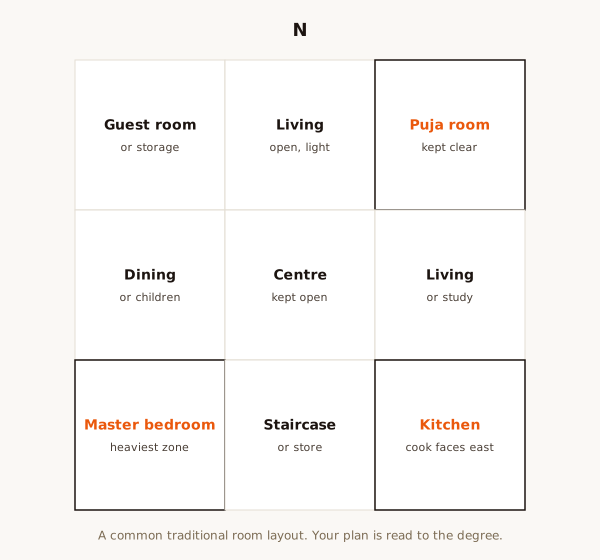
Online consultations do not include this scan. Their reports say so, and the rest of the analysis is complete. An online assessment uses traditional Vastu only, the 16-zone map and the 3×3 grid drawn on your plan; geopathic stress readings need a site visit.
What a full report adds
The full version is longer than this sample. It includes the annotated floor plan with the zone grid drawn over it, every compass and instrument reading taken, all 16 zones, and notes for an interior designer if work is planned. It arrives within 48 hours of the visit.
Questions about any item can be sent on WhatsApp after you receive it, and nearby clients can ask for an on-site check once the changes are in place.
Why the corrections need no construction
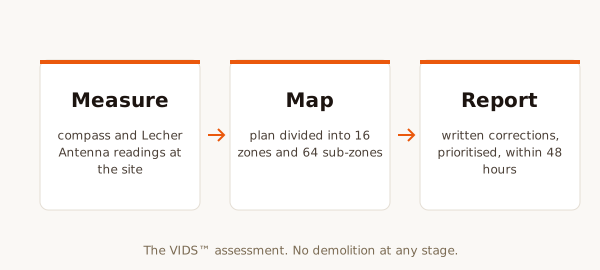
Every recommendation in the sample uses placement, lighting, colour or a change in how a room is used. None of them requires a contractor or a purchased product. That is the normal pattern. Where something truly needs building work, a report says so clearly. The zero-demolition corrections guide shows more examples.
Reports for other property types
The structure stays the same for other properties, while the content changes. An office report focuses on reception, cabins, seating and the accounts area. A factory report adds machinery, power, raw material and dispatch. A plot report looks at shape, slope, road position and tilt before you buy.
Getting your own report
Fees are fixed by property type: ₹5,000 for an online consultation anywhere, ₹15,000 for a Bangalore apartment or row house, and ₹25,000 for a Bangalore villa or independent house. The pricing page lists outstation and commercial fees. The preparation guide explains what to keep ready before the visit.
Questions to ask about any Vastu report
Whether the report comes from us or from another consultant, a few questions show whether the Vastu advice can be trusted:
- Does the Vastu report give measured degrees, or only general directions?
- Is each Vastu recommendation linked to a specific zone and reading?
- Are the corrections ranked, so you know what to do first?
- Does any Vastu remedy depend on buying a product?
- Is demolition offered as the first answer?
A good Vastu report answers all of these on paper, so you can check the reasoning yourself.
Using the sample vastu report before you book
Many people read this sample before deciding between an online and an on-site Vastu consultation. If your main concern is a room where you sleep or work, an on-site visit adds the Lecher Antenna scan. If you live outside Bangalore, the online Vastu consultation follows the same report format. The online versus on-site guide compares the two.