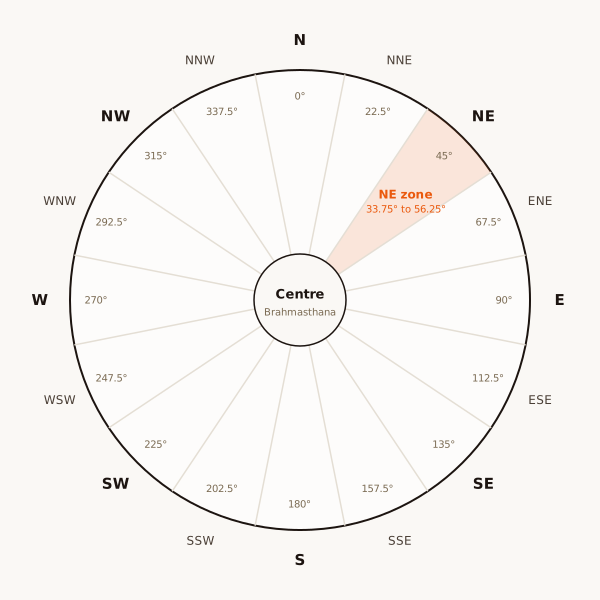
The 16 Vastu zones are sixteen equal directional segments of 22.5 degrees each, measured clockwise from north around the centre of a property: N, NNE, NE, ENE, E, ESE, SE, SSE, S, SSW, SW, WSW, W, WNW, NW and NNW. Using sixteen zones instead of four or eight lets us locate rooms, doors and objects precisely, rather than calling everything on one side of the house by the same name.
This guide gives the exact degree range of each zone, explains why the circle is divided this way, describes the traditional character of each group of zones, and shows how we measure them on a real site. It is the reference behind every Vastu report we write using the VIDS method.
Why 16 Vastu zones and not 8
With eight directions, each covers 45 degrees. That is a wide band: two doors 40 degrees apart could be described as the same direction, even though they sit in quite different parts of the wall. Splitting the circle into sixteen zones of 22.5 degrees halves that uncertainty.
In practice this means we can say that a main door sits in the east-north-east zone rather than simply “east”, or that a stove falls in south-south-east rather than south-east. The elemental associations of the eight classical directions stay the same; the map just becomes more precise. The Vastu directions explained article covers those eight directions in detail.
Degree ranges of all 16 zones
| Zone | From | To |
|---|---|---|
| North (N) | 348.75° | 11.25° |
| North-north-east (NNE) | 11.25° | 33.75° |
| North-east (NE) | 33.75° | 56.25° |
| East-north-east (ENE) | 56.25° | 78.75° |
| East (E) | 78.75° | 101.25° |
| East-south-east (ESE) | 101.25° | 123.75° |
| South-east (SE) | 123.75° | 146.25° |
| South-south-east (SSE) | 146.25° | 168.75° |
| South (S) | 168.75° | 191.25° |
| South-south-west (SSW) | 191.25° | 213.75° |
| South-west (SW) | 213.75° | 236.25° |
| West-south-west (WSW) | 236.25° | 258.75° |
| West (W) | 258.75° | 281.25° |
| West-north-west (WNW) | 281.25° | 303.75° |
| North-west (NW) | 303.75° | 326.25° |
| North-north-west (NNW) | 326.25° | 348.75° |
These ranges are pure geometry. 360 divided by 16 is 22.5, and each zone is centred on its compass point. North, for example, is centred on 0 degrees and runs from 348.75 to 11.25 degrees, which is why it is the only zone that crosses zero.
Traditional guidance for the northern zones
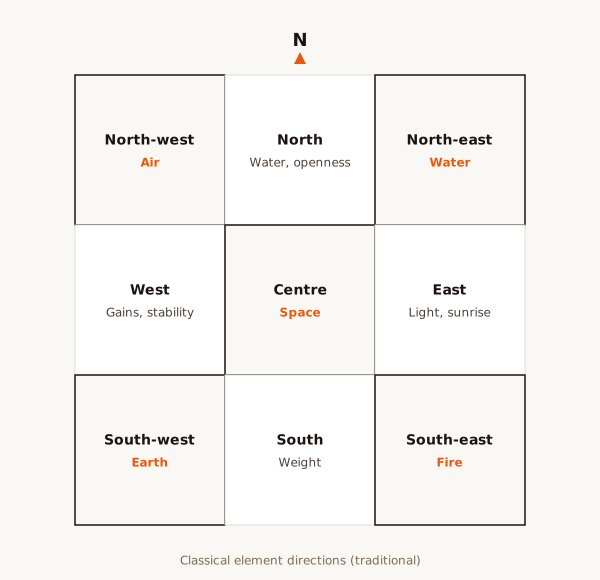
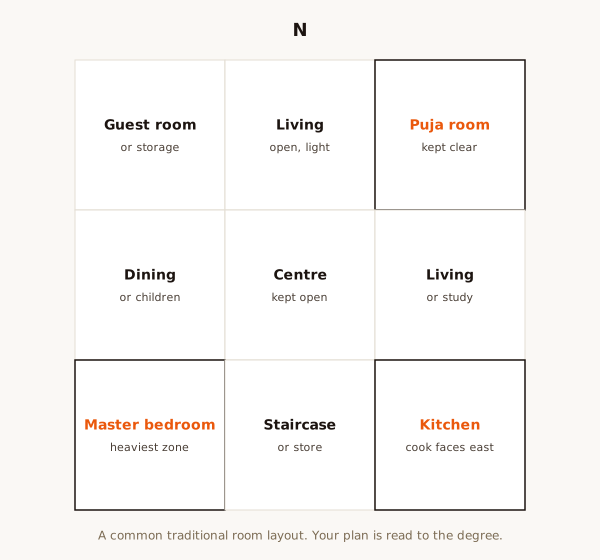
Traditional guidance: the north and north-east quarter is linked with water, openness and light. North (N) is associated with resources and opportunity, NNE with health and freshness, and NE (Ishanya) is the most sensitive zone of all, best kept open, clean and light, and suited to puja or quiet reflection. ENE, leaning towards the east, is often treated as a place for relaxation and family time.
What we measure: whether toilets, kitchens, heavy storage or overhead tanks fall in these zones, and how much light reaches them. A toilet in NE is one of the most common findings in compact apartments.
Traditional guidance for the eastern and south-eastern zones
Traditional guidance: East (E) is the direction of sunrise and new beginnings, suited to entrances, living rooms and study. ESE leans towards fire and is often kept for activity rather than rest. South-east (SE, Agneya) is the classical fire zone, the natural home of the kitchen, and in business, of electrical panels and heat-producing equipment. SSE continues that fire character.
What we measure: the exact position of the stove, the electrical panel or the inverter. A stove in SSE and one in SE are close but distinct, and a report treats them accordingly.
Traditional guidance for the southern and south-western zones
Traditional guidance: South (S) is associated with rest and firmness, and suits bedrooms and solid walls. SSW and SW (Nairutya) carry the earth element, linked with stability, weight and authority. SW is the classical place for the master bedroom, the head of the family and the heaviest storage. WSW, moving towards the west, is often associated with learning and study.
What we measure: whether the SW is solid and occupied or open and empty, and whether a door, toilet or cut in the plot falls in these zones.
Traditional guidance for the western and north-western zones
Traditional guidance: West (W) is associated with gains and steady results, suiting dining and children’s rooms. WNW and NW (Vayavya) carry the air element and the quality of movement, so they suit guest rooms, utility areas and, in a business, dispatch and finished goods. NNW, next to north, is often linked with rest and relationships.
Different schools describe some of these finer zones in slightly different words. Where that matters for your property, the report says which interpretation we are using and why.
How the zones are measured on site
- Find the centre of the property (the Brahmasthan) from an accurate floor plan
- Take compass readings at several points, away from steel, wiring and appliances that distort the needle
- Correct magnetic north to true north using the local magnetic declination
- Align the plan to true north and draw 16 lines from the centre at 22.5-degree intervals
- Note which rooms, doors, water points, fire points and heavy objects fall in which zone
Magnetic declination differs from place to place and changes slowly over time. You can check it for any location on the NOAA magnetic declination calculator. For homes abroad, the reference used is stated in the report.
Finding the centre of an irregular plan
Everything depends on the centre, because the 16 Vastu zones radiate from it. For a simple rectangle, it is where the diagonals cross. Most Bangalore homes are not simple rectangles: they have balconies, cut corners, projections and L-shapes.
For irregular plans we find the centre of the main built area, treat small projections separately and note any cut or extension as a finding in its own right. A missing corner, for example in the north-east or south-west, is often more significant than the precise room placement inside.
Accuracy and common errors
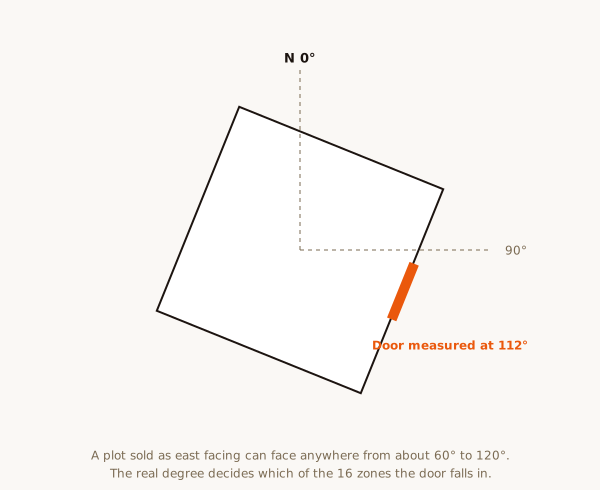
Phone compasses can be off by several degrees indoors. On site we take readings at multiple points and discard outliers. A small error is not a problem in the middle of a zone, but near a boundary it can move a door or a stove into the next zone, which is why careful measurement matters more with 16 zones than with eight.
The other common error is drawing the zones from the main door instead of from the centre. The zones belong to the whole building, not to its entrance.
How the zones guide corrections
Once the zones are drawn, each room and object can be checked against the function its zone traditionally suits. Where there is a mismatch, we look for the simplest response first: changing how a room is used, moving furniture or storage, adjusting colour and lighting, or clearing clutter. We do not suggest demolition by default. If something genuinely needs construction, the report says so plainly.
Our zero-demolition corrections article shows typical examples, and the sample Vastu report shows how a zone map is presented.
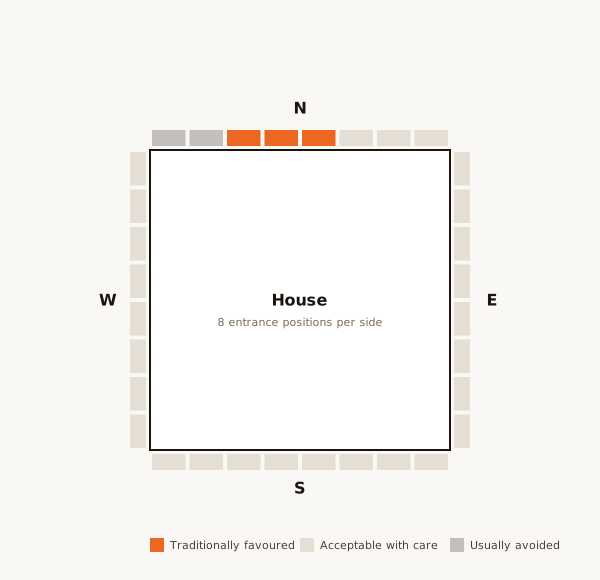
16 zones and the 32 entrance positions
Entrances are read even more finely. Classical practice divides the perimeter into 32 entrance positions, or padas, eight on each side. The 16-zone map tells us which part of the house a door opens into; the pada tells us the exact position of the door along its wall. Both are part of how we assess a main door. See Vastu for main door for more on entrances.
Zones in apartments versus independent houses
In an independent house, the Vastu zones are usually drawn twice: once for the plot, from the centre of the land, and once for the built house. A sump, borewell or car shed in the plot can then be read against the plot zones, while rooms are read against the house zones.
In an apartment, we draw the Vastu map for the flat itself, from its own centre, not for the whole tower. The building orientation tells us roughly where north lies, but the flat may sit on any side of the block, so its own zones are what matter for daily life. Our Vastu for apartment page explains how that works in practice.
Can you map the zones yourself?
Yes, roughly. Take a printed plan, find the centre, take a compass reading at the main door and draw sixteen lines at 22.5-degree intervals. It is a useful exercise before a Vastu consultation, and it helps you follow the report afterwards.
What a home-made Vastu map usually misses is accuracy near the zone boundaries, the correction for declination and the judgement about what to prioritise. If you try it, treat the result as a first sketch, and see our guide on how to prepare for a Vastu consultation for the readings worth sending us.
Next step
The 16 Vastu zones are a measuring tool; their value comes from applying them carefully to a real building. To have your own home mapped, see Vastu for home or the online consultation, read about our methodology, or book a consultation directly. An online assessment uses traditional Vastu only, the 16-zone map and the 3×3 grid drawn on your plan; geopathic stress readings need a site visit.