Mirror vastu is one of the most searched Vastu topics, and one of the most misunderstood. People ask where a mirror should hang, whether a mirror facing the bed is a problem, and whether a mirror can “fix” a Vastu defect. This guide sets out what traditional guidance says, what we can actually observe and measure in a room, and where the popular claims go further than the tradition does.
Throughout, we keep three things apart, as we do in every Vardhini Vastu report: what is measured on site, what is traditional guidance, and what is interpretation. Nothing here needs demolition. We do not sell greed and fear.
What mirror vastu is about
In Vastu tradition a mirror is treated as something that doubles what it faces. A mirror that reflects light, an open view or a tidy room is read as helpful; a mirror that reflects clutter, a toilet door or a sleeping person is read as unsettling. Most mirror vastu rules come from this one idea.
There is also a practical side that anyone can check. A mirror changes how light moves through a room, it can bounce glare into your eyes, and it can make a small room feel larger or more restless. Those effects are real and observable, and they matter as much as the traditional reading.
Traditional guidance: which walls suit a mirror
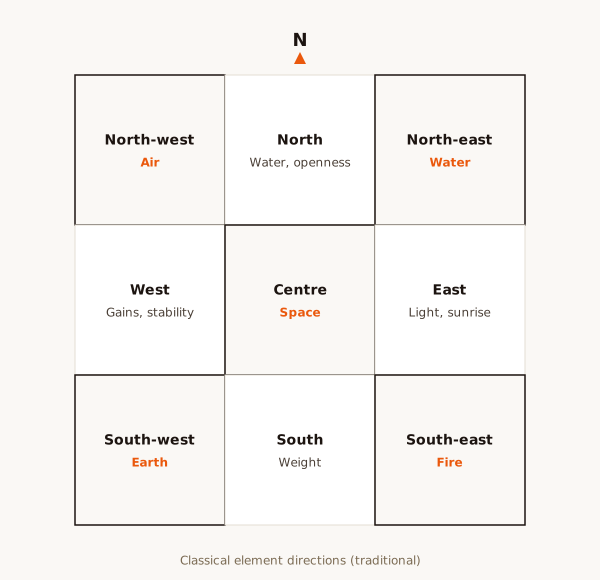
Traditional guidance: the North and East walls are the ones most often recommended for mirrors, especially large ones. These directions are linked with water and air in the five element scheme, and with morning light, so a mirror there is read as adding openness.
- North wall: widely recommended for mirrors and glass.
- East wall: also widely recommended, especially in living rooms.
- North-East: suitable for a small, clean mirror; keep the corner light and uncluttered.
- South and West walls: generally not preferred for large mirrors in tradition.
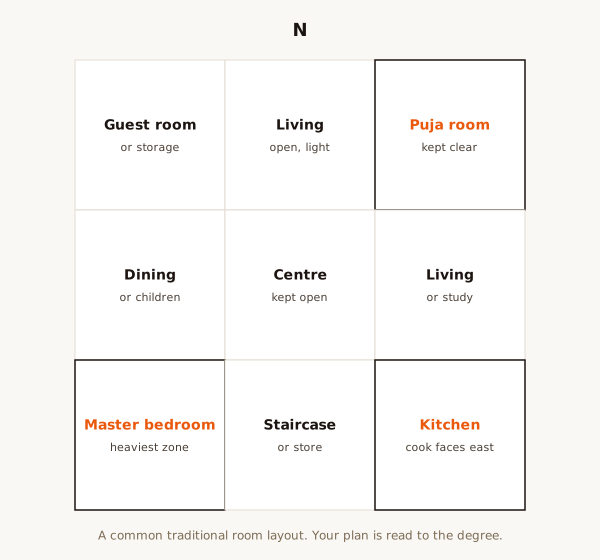
- South-West: traditionally the most stable, heaviest zone; large mirrors here are usually avoided.
Schools vary in detail, so treat this as broad guidance, not a rule that overrides everything else in the room.
Mirror facing the bed
This is the question we are asked most. Traditional guidance avoids a mirror that reflects the bed, especially the person sleeping. The usual explanation is that it disturbs rest. We do not make health claims, but there is a simple practical point: a mirror opposite the bed catches light from windows, street lamps and screens and can make a dark room less dark.
The fix is easy and needs no demolition: move the mirror to a side wall, turn the dressing table, or cover the mirror at night with a curtain or a hinged door. A wardrobe with a mirrored door facing the bed can be handled the same way.
Mirrors in the living room and hall
In the living room a mirror on the North or East wall is the common traditional choice. It should reflect something pleasant: a window, plants, light, an open part of the room. Avoid placing it where it reflects the main door straight back at anyone entering, which many households find uncomfortable as well as being traditionally avoided.
Decorative mirror groups and mirror panels follow the same reading. Keep them clean and unbroken, and check that they do not throw afternoon glare across the seating.
Dressing tables and bedroom mirrors
A dressing table is usually placed so that the person faces North or East while using it. That is the traditional preference; the practical test is whether there is good light on the face from a window.
- Place the dressing table on a side wall rather than opposite the bed.
- Keep the mirror at a height that does not reflect the bed when you look from it.
- Avoid a mirror on the wall behind the headboard.
- Keep the dressing area clear; clutter is what tradition dislikes most.
Bathroom and wash basin mirrors
Mirrors above wash basins are normal and do not need special treatment. Traditional guidance prefers the basin and its mirror on the North or East wall of the bathroom where that is possible. The more common real issue is a bathroom door that opens straight onto a bedroom mirror; turning the mirror or keeping the door closed solves it.
Read more about the bathroom itself in our guide to Vastu for toilet and bathroom.
Mirrors opposite the main door, toilets and kitchens
Three placements are avoided in most traditional readings: a mirror that reflects the main door from inside, a mirror that reflects a toilet door, and a mirror that reflects the kitchen stove. Each is easy to check by standing where the mirror is and looking at what it sees.
If you cannot move the mirror, change what it reflects: a curtain, a screen, a plant or a door kept closed does the same job.
Broken, cracked and convex mirrors
Tradition is consistent that broken or cracked mirrors should be replaced, and most people agree for safety alone. Convex or “bagua” style mirrors sold as protection come from other traditions and are not part of classical Vastu; we do not use or sell them.
Can a mirror correct a Vastu defect?
Some videos claim a mirror can “extend” a missing corner or cancel a defect such as a North-East cut. Classical texts do not say this, and nothing about a mirror changes the measured shape of a plot. We list this among the common Vastu myths.
What a mirror can do is change how a room feels and how light moves. That is useful, and it is honest to describe it that way rather than as a remedy for a structural feature. For real corrections without construction, see zero demolition Vastu corrections.
What we check on site
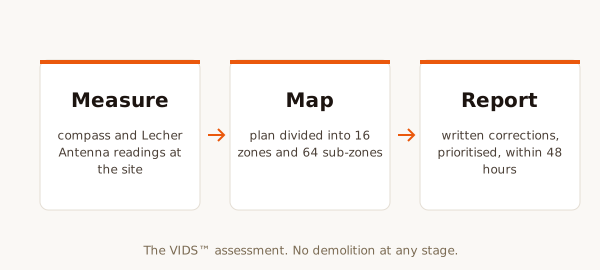
On a visit we measure the true-north direction of each wall with a compass and correct it for magnetic declination, which in Bangalore is small but real; you can look up the value for any place on the NOAA magnetic declination calculator. We then note what each mirror reflects, where light falls during the day, and which zone of the home it sits in on the 16-zone map.
Mirror findings go into the written report as simple placement notes, ranked below anything to do with the entrance, kitchen, toilets and bedrooms, because those matter more. See how the full process works on our Vastu methodology page.
Mirror vastu in apartments
Bangalore flats often have mirrored wardrobe shutters, a mirror panel near the entrance and a mirror above every basin. In a compact flat the rules matter less for the number of mirrors than for what each one faces. Stand in front of each mirror and look at what it shows: the bed, the main door, a toilet door or the stove are the four things to move away from. A mirror that shows a window or a balcony usually works well.
If the builder has fixed a mirrored wardrobe opposite the bed, a light curtain rod over the shutters or a fabric panel at night is enough. Nothing needs to be broken or replaced.
Mirrors in offices and shops
In offices a mirror is rarely needed, but if there is one, the North or East wall is the usual choice and it should not reflect the main entrance back towards visitors. In shops and showrooms, mirrors that reflect stock or display shelves are common and traditionally welcome, especially on the North or East walls; a mirror behind the cash counter that reflects the counter itself is a common custom rather than a classical rule. Our Vastu for shops page covers the rest of a retail layout.
How mirror vastu fits the 16 zones
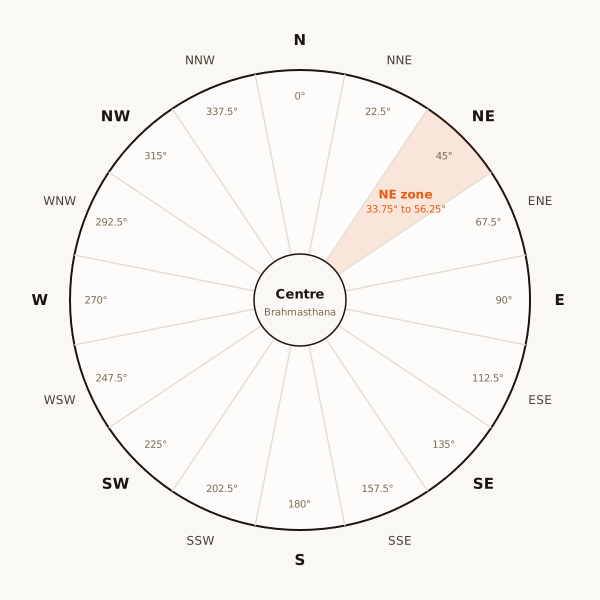
The 16-zone map divides a home into 16 sectors of 22.5 degrees each, measured from true north at the centre of the plan. A mirror’s zone is simply the sector of the wall it hangs on. Because walls in Bangalore flats are rarely aligned exactly with the compass, a wall that looks like the North wall may belong to the North-North-West or North-North-East zone. Our guide to the 16 Vastu zones explains how the sectors are drawn.
For most homes, getting the zone exactly right matters less for a mirror than for a kitchen, toilet or entrance. Use the zone as a guide, then use the simple test of what the mirror reflects.
Common mirror mistakes we see
- A full-length mirror opposite the bed, often on a wardrobe door.
- A mirror in the foyer that reflects the main door straight back.
- A mirror on the South-West wall of the master bedroom.
- Old, foxed or cracked mirrors kept because they were a gift.
- A mirror panel used to “extend” a missing corner, based on online advice.
Every one of these is fixed by moving, covering or replacing a mirror, usually in an afternoon.
A quick mirror vastu checklist
- Large mirrors on North or East walls where possible.
- No mirror reflecting the bed, or cover it at night.
- No mirror reflecting the main door, a toilet door or the stove.
- Replace broken or cracked mirrors.
- Make each mirror reflect light, plants or open space, not clutter.
- Do not rely on mirrors to fix cuts or extensions.
Getting your home assessed
Mirrors are a small part of a full reading. Our Vastu for home service covers every room, the entrance and the kitchen; the sample Vastu report shows the format you receive within 48 hours, and fees are on the consultation fees page. You can also check your own plan first in the free 16 Zone Vastu Chakra Tool.