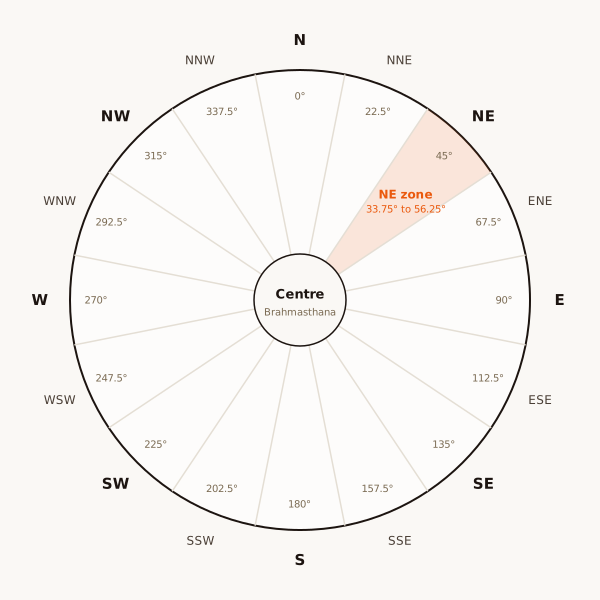
The VIDS 16 zone framework is the method we use to read every property at Vardhini Vastu, whether it is a two-bedroom flat in Whitefield or a factory shed on the edge of the city. Instead of judging a building by four or eight broad directions, we divide it into 16 directional zones of about 22.5 degrees each, measured from true north on site.
This guide explains how the framework is built, why we work with 16 zones rather than 8, how the 64 padas fit inside them, and what a zone reading can and cannot tell you. Where a point comes from the classical Vastu texts we say so. Where it comes from our own measurement on site, we label that too, so you can tell the two apart.
What the VIDS 16 zone framework is
VIDS™ is the structured diagnostic system developed by Raghavendra Hebbur over more than ten years of residential, commercial and industrial consultations in and around Bangalore. It is not a new set of Vastu beliefs. It is a repeatable way of applying classical principles so that two readings of the same building, taken on different days, arrive at the same zone map.
The framework does three jobs. It fixes the orientation of the property accurately. It divides the plan into 16 zones and 64 smaller padas. And it gives every room, door, appliance and activity a precise position on that grid, so the advice that follows is about your actual layout rather than a general rule copied from a book.
Because the same grid is used for every property type, the method scales. A one-room studio and a forty-acre industrial plot are read with the same logic, only the boundary and the level of detail change.
Why 16 zones instead of the traditional 8 directions
Most popular Vastu advice works with eight directions: the four cardinal points and the four corners. Each of those covers 45 degrees. That sounds precise until you stand inside a real house. A room described as North-East could sit at 25 degrees or at 65 degrees from north, and those two positions behave very differently once you look at what lies on either side.
Splitting each 45 degree sector into two gives 16 zones of 22.5 degrees. The extra resolution tells us whether a feature sits at the heart of a direction or on its edge, where it begins to share the character of the neighbouring zone. In practice the 16 zones are:
- North, North-North-East, North-East, East-North-East
- East, East-South-East, South-East, South-South-East
- South, South-South-West, South-West, West-South-West
- West, West-North-West, North-West, North-North-West
The 16 zone structure is not about adding complexity for its own sake. It is about being specific enough that a correction can be placed in the right corner of the right room.
Traditional associations of the main directions
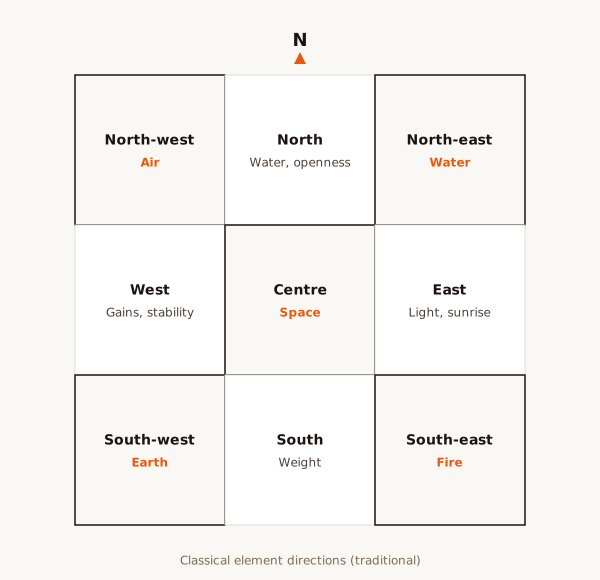
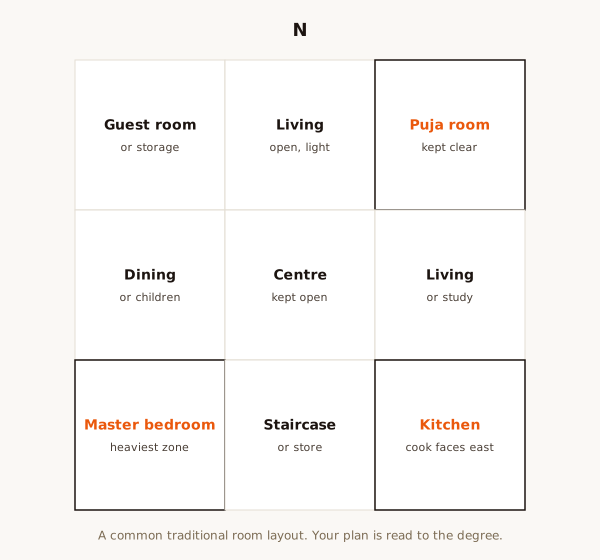
Traditional guidance: classical Vastu texts give each of the eight main directions an elemental and functional character. The North-East is associated with water and clarity, which is why it is kept light and open. The South-East is linked to fire, the traditional home of the kitchen. The South-West is tied to earth and stability, favoured for the master bedroom and heavy storage. The North-West is linked to air and movement, often suggested for guest rooms and vehicles. The centre, the Brahmasthana, is kept open and uncluttered.
What we measure: in the framework, the in-between Vastu zones are read as transitions. A room in East-South-East, for example, carries something of the East and something of the South-East, and the recommendation reflects both. We prefer this to assigning every sub-zone a fixed meaning, because the classical sources describe directions and the grid, not a modern list of sixteen labels.
Sixty-four padas: the finer grid
Each of the 16 primary zones is divided again into four padas, which gives 64 points of analysis across a full property. This connects directly to the classical Vastu Purusha Mandala, the square grid that traditional builders used to plan temples, homes and towns. The 64 square version, known as the Manduka mandala, is one of the grids described in the old Vastu and architectural literature.
The padas matter most for entrances and small features. A main door that spans two padas, a puja shelf in a corner, an overhead tank on a terrace: each can be located precisely, so the report can say which pada it falls in rather than offering a broad directional statement.
How we take the reading on site
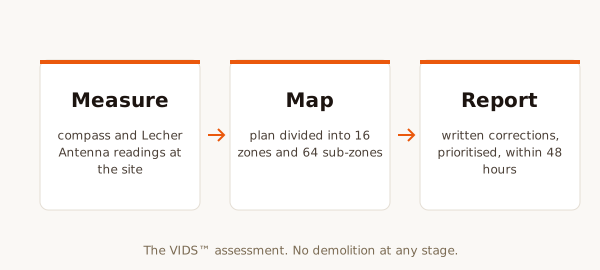
Every Vastu reading depends on orientation, so we never estimate it. On a site visit we take several compass readings at different points, away from steel grills, electrical panels and parked vehicles, which can pull a needle by several degrees. We then cross-check against the building plan and satellite imagery.
A magnetic compass points to magnetic north, not true north. The difference is called magnetic declination and it changes with location and year. In Bangalore it is small, but for outstation and overseas properties it can be large enough to move a feature from one zone into the next. We correct for it using the NOAA magnetic declination calculator before the grid is drawn.
Next we fix the centre of the property, the Brahmasthana, from the actual boundary. For an apartment that is the unit, not the tower. For an irregular plot we work out the centre carefully, because the whole wheel pivots on that point.
Starting from the entrance
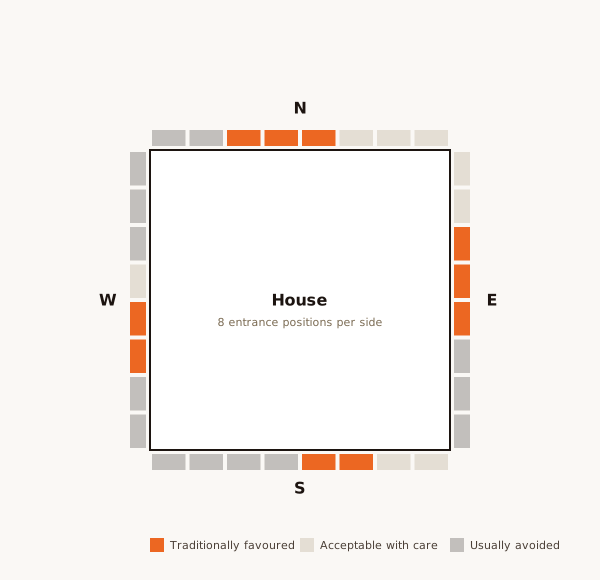
The first feature we place on the grid is the main entrance. Its zone sets the tone for how energy and movement enter the home, and it is the reference point for the rest of the analysis. A door in North or East is traditionally favoured, but within those directions some padas are read as stronger than others, which is exactly what the finer grid reveals.
If you want to understand entrances in more depth, our guide to main door and entrance placement goes through each direction in turn.
What a zone reading identifies, and what it does not
A Vastu zone reading is not a pass or fail stamp. Take a kitchen. The reading identifies which zone and pada it falls into, what that zone is traditionally associated with, and whether the fire element of cooking is supported or in tension with that position. The recommendation then responds to that specific finding.
The same applies to bedrooms, toilets, staircases, borewells and storage. Each is placed, each is compared with the traditional association of its zone, and each gets a proportionate response. A toilet in the North-East, for instance, is treated very differently from a toilet in the West-North-West.
What a reading does not do is predict events. Vastu principles on this site are presented as traditional interpretation and practitioner method, not as claims proven by controlled scientific research. Where advice rests on a measurable factor, such as daylight, ventilation or a magnetic reading, we say so separately.
Where the Lecher Antenna fits
Directional Vastu zones are one layer. Where a site visit is possible, we add a Lecher Antenna reading to check for geopathic stress, such as underground water lines or other disturbances beneath a bed or work desk. This is a separate check that sits alongside the zone map, not part of it.
Online consultations use the directional analysis only, since the instrument has to be used in person. For many apartments and offices the directional reading alone is enough to produce a clear, practical plan. An online assessment uses traditional Vastu only, the 16-zone map and the 3×3 grid drawn on your plan; geopathic stress readings need a site visit.
Classical roots: the Aparajitaprccha and the Vishvakarma tradition
The framework rests on the Vishvakarma tradition of Indian architecture, the body of classical texts that describe orientation, the mandala grid and the placement of functions within a building. Raghavendra Hebbur is translating the Aparajitaprccha, a twelfth century treatise in this tradition, and that study keeps the method anchored in the source material rather than in later popular simplifications.
We do not quote verses on the site or claim that any one text prescribes the sixteen zone grid in modern form. The 16 zone division is a practical refinement of the Vastu directional principles those texts describe.
Applying the VIDS 16 zone framework without demolition
Every recommendation that comes out of a VIDS™ reading is designed to work without breaking walls. Typical Vastu corrections include:
- Changing how a room is used, for example moving a study table or a bed rather than the room itself
- Placement of furniture, storage and heavy items in the zones that suit them
- Colour choices on walls, floors and furnishings matched to the zone element
- Lighting changes, especially for dark corners and the centre of the home
- Decluttering zones that are traditionally kept light and open
Very occasionally a feature such as a water sump or an external staircase cannot be balanced by these methods. When that happens we say so plainly and explain the option, rather than suggesting a product. We sell nothing and take no commission from builders. Our page on zero-demolition corrections explains the approach in detail.
Can you read the zones yourself?
You can take the first step at home. Stand in the centre of your house with a phone compass, away from metal, and note the bearing of your main door. Repeat it two or three times. That single number is the most useful thing to bring to a Vastu consultation.
The full 64 pada analysis, the declination correction and the interpretation of how rooms interact is what a consultation provides. Our checklist on how to prepare for a consultation lists what else to keep ready, and the article on 16 zones explained gives a simpler introduction to each direction.
Using the framework for your own property
If you would like the method applied to your own home, office or plot, the methodology page sets out each stage, and the sample report shows what the finished zone map looks like. You can choose an online Vastu consultation from anywhere or a site visit in Bangalore. When you are ready, you can book a Vastu consultation and we will start with the entrance reading.