Vastu vs Feng Shui is a common question, because both traditions read buildings by direction and both are now practised around the world. They share a broad idea, that the way a building sits in its environment affects how it feels to live in, but they come from different places, rest on different systems, and frequently give different advice for the same room. Mixing them without understanding either is one of the most common sources of confusion we meet.
This guide compares the two honestly: where each comes from, how each reads a space, where they agree and where they differ. We practise classical Vastu only, and we say so plainly, but we have no interest in dismissing another tradition.
Origins of each tradition
Vastu developed in India and was recorded in Sanskrit treatises written for master builders, such as the Mayamata, the Manasara, the Samarangana Sutradhara and the Aparajitaprccha. It covers site selection, orientation, proportion and the placement of rooms, and it was applied to temples, towns and homes alike. See what Vastu Shastra is.
Feng Shui developed in China. Its name means wind and water, and its early practice concerned the siting of graves and buildings in a landscape of hills and water. It later grew into several schools, broadly a form school that reads landforms and shapes, and a compass school that reads directions with a specialised compass.
How each reads a building
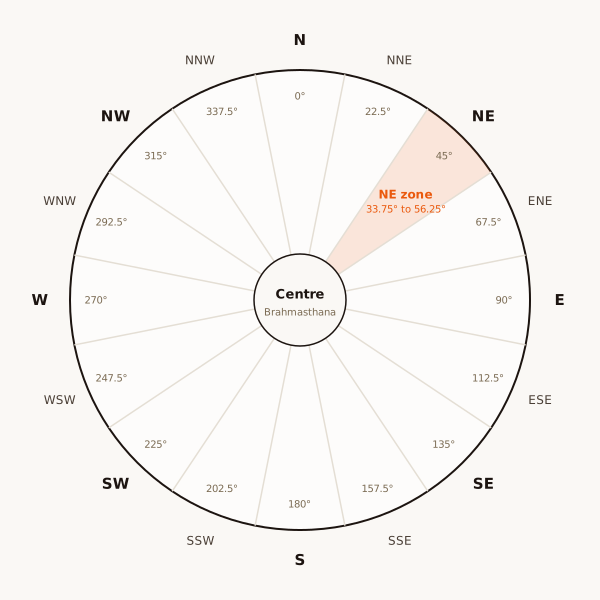
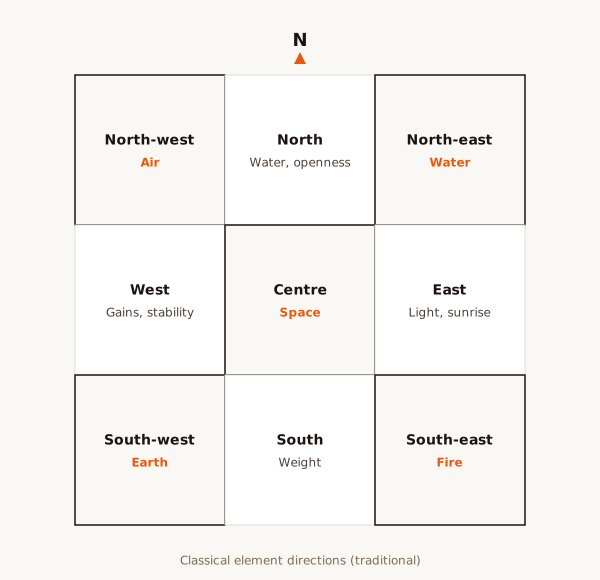
Vastu reads a building from its centre outwards. It lays the Vastu Purusha Mandala grid over the plan, divides the space into eight directions or 16 zones of 22.5 degrees, and places each activity where tradition says it belongs: fire in the south-east, water in the north-east, weight in the south-west, movement in the north-west and open space at the centre.
Feng Shui commonly uses the bagua, an eight-part map linked to the trigrams of the I Ching. Depending on the school, the bagua is oriented by compass direction or by the position of the front door. Feng Shui also places strong emphasis on the flow of qi, on the shapes of the surroundings and on the arrangement of objects within a room.
Two different element systems
Both traditions speak of five elements, but they are not the same five.
- Vastu: earth, water, fire, air and space, the pancha mahabhuta, each with a home direction.
- Feng Shui: wood, fire, earth, metal and water, linked by cycles in which elements generate or control one another.
Because the systems differ, the advice differs. Feng Shui may suggest a metal object to balance a zone, while Vastu reads the same zone by its pancha mahabhuta element and what the room is used for. See Vastu five elements.
Where Vastu and Feng Shui agree
- A bright, uncluttered entrance is welcome in both.
- Both dislike clutter, especially at the centre and near the entry.
- Both value light and moving air through the home.
- Both prefer a solid wall behind the bed and behind a seated head of the house or business.
- Both read the land around a building, including roads, water and tall neighbours.
These shared points are also good building practice, which is one reason they appear in both traditions.
Where they differ
- Directions: Vastu fixes zones by true north for every building. Some Feng Shui schools orient the map from the front door instead.
- Remedies: Feng Shui practice often uses objects such as wind chimes, crystals, mirrors and figurines. Classical Vastu works mainly through placement and room use.
- Water: Vastu places water in the north-east and north. Feng Shui places water features according to its own school and calculations.
- Mirrors: the traditions give different advice about mirrors facing the bed or the door.
- Climate: Vastu grew up with the Indian sun path and monsoon, which shapes many of its rules.
The problem with mixing them
Many homes we visit have a mixture: a Vastu kitchen, a Feng Shui wind chime at the door, a crystal on a window sill and a pyramid under a bed. The result is usually confusion rather than balance, because the two systems were never designed to be combined. One tradition may recommend exactly what the other discourages.
Our advice is simple. Choose one tradition and apply it consistently. If you choose Vastu, follow its reading by direction and room use, and remove objects that were added out of worry rather than reason.
Which suits Indian homes
For homes in India, Vastu has a practical advantage: its rules grew from the Indian climate, the sun path across the subcontinent and Indian ways of cooking, worship and family life. Its placement of the kitchen, the prayer space and the master bedroom fits how most Indian households actually live. Many architects and builders here already plan with it in mind.
That does not make Feng Shui wrong for those who follow it. It simply means that, for most Indian families, Vastu speaks more directly to the house they live in.
How we practise Vastu
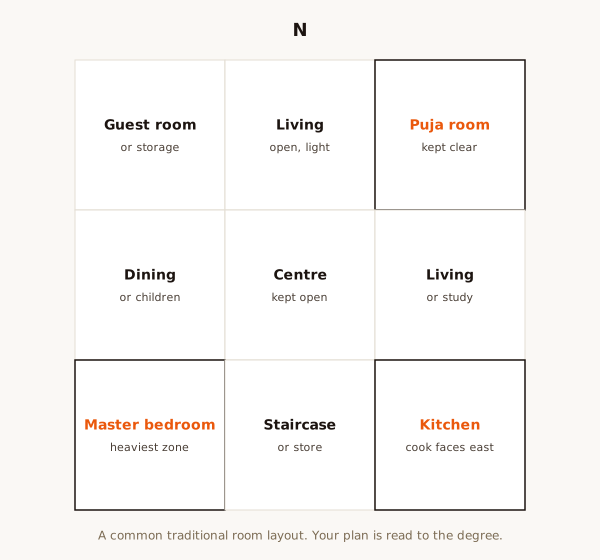
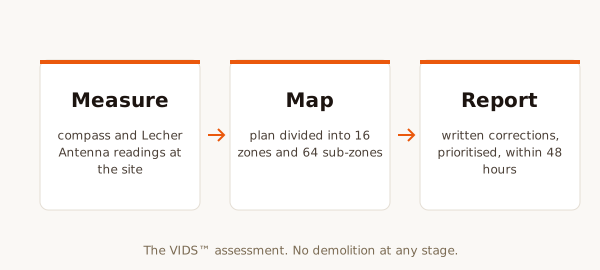
We practise classical Vastu with measurement. Every reading starts from true north, corrected for magnetic declination, which you can check with the NOAA magnetic declination calculator. We draw the 16-zone map and a 3×3 grid over your plan and read each room by its measured zone. We separate what we measured from what tradition says, and we make no promises about health, wealth or relationships.
We sell no products and use none as remedies. Corrections come from room use, placement, colour, light and ventilation. See scientific Vastu and our methodology.
Room by room: how the advice compares
Kitchen. The Indian tradition is specific: the south-east first, the north-west as an alternative, and the cook facing east. Feng Shui looks more at the relationship between the stove, the sink and the door, and at keeping fire and water apart within the room. Both agree that a stove should not sit directly in line with the entrance.
Bedroom. The Indian texts place the main bedroom in the south-west and prefer sleeping with the head to the south or east. Feng Shui focuses on the command position, where the bed sees the door without being in line with it, and on a solid wall behind the headboard.
Entrance. Both value a bright, open entry. The Indian system reads the exact position of the door along its wall using 32 positions, while Feng Shui reads the door as the mouth of qi and looks at what it faces.
Water features. The Indian system keeps water in the north-east and north. Feng Shui practice places water according to its school and often according to calculated periods, which can lead to very different positions.
A note on objects and remedies
Much of what is sold as a home remedy today, from crystals and pyramids to wind chimes, figurines and coins, comes from popular practice rather than from the classical building texts of either tradition. The old Indian treatises are about where walls, doors, rooms and water go. They are not catalogues of objects.
This is one reason we keep our work to placement and room use. A change that costs nothing, such as moving a bed, clearing a corner or swapping two rooms, is easier to judge honestly than a purchase. If you have objects at home that you added out of worry, it is reasonable to ask what each one is for and whether you still want it there.
Choosing between the two
If your family already follows one tradition, keep to it. If you are starting fresh, choose the one that fits how your household lives, and then apply it consistently rather than borrowing single rules from each.
Whichever you choose, prefer a practitioner who measures direction properly, explains which statements rest on tradition and which on observation, and does not promise outcomes. That standard matters more than the name of the system.
Questions people ask us about Vastu vs Feng Shui
My builder followed one system and my relatives another. What now? Start with a measured reading of the house as built. Many apparent conflicts disappear once the true directions are known, and the rest can be settled by choosing one approach.
Is one more scientific than the other? Neither has been tested the way building science tests ventilation or daylight. What can be measured is orientation, sunlight, airflow and moisture, and we report those separately from traditional rules.
Does either need demolition? No good practitioner of either should start there. Room use and arrangement come first. Read about our zero-demolition approach.
Where can I read the myths? Our article on common myths and the evidence answers the questions we hear most often.
Your next step
If your home has been arranged with a mix of traditions and you want a clear reading, start with Vastu for home. When you are ready, book a consultation and receive a measured, written report within 48 hours.