Lecher antenna Vastu surveys raise more questions than almost anything else we do, usually from people who have read something alarming online about energy lines under their bed. This guide explains what the Lecher Antenna is, where its name comes from, how we use it on a Vastu site visit, and what it can and cannot tell you. We use the tool ourselves, and we would rather you knew its honest status before deciding whether it matters to you.
Raghavendra Hebbur is a Lecher Antenna practitioner and a Certified Geo Master, and he also uses the Universal Aura Scanner (UAS) by Geo Engineering. In our Vastu work these readings are one layer added on top of measured directions. They never replace the measurements, they are never used to frighten anyone, and they are never a route to selling a product.
What the Lecher Antenna is
The instrument most practitioners carry is light and simple: two parallel metal rods joined at one end, a handle, and a sliding contact that can be set to marked positions along the rods. The practitioner holds it level and walks slowly. At certain points the tip dips or swings, and the practitioner records that as a reading at the setting in use.
The name comes from Ernst Lecher, an Austrian physicist who in 1888 used a pair of parallel wires to measure the wavelength of high-frequency electrical waves. Lecher lines are real, well understood physics and are still taught in radio engineering. The dowsing instrument used in building surveys borrows that name and shape, but it works in a different way: the movement of the tip comes through the practitioner’s hands and is interpreted against a learned scale.
We point this out because it is easy to blur the two. The physics apparatus does not validate the dowsing use, and it would be misleading for any Vastu consultant to borrow the credibility of one for the other.
The honest status of the tool
Here is where the Lecher Antenna stands, stated plainly:
- It is a radiesthesia, or dowsing-type, tool used in the Geo Vastu tradition and in European building biology.
- It is not accepted by mainstream science. Controlled studies of dowsing have not produced results that mainstream science accepts.
- Its results are practitioner readings. Two practitioners walking the same room may not mark a line in exactly the same place.
- There is no published standard that turns a reading into a measured quantity, the way a compass gives degrees or a lux meter gives light levels.
None of this means the tool is useless to everyone. Many households find the reading a helpful prompt to rethink where a bed or desk sits. It does mean that we label every antenna finding as interpretive, and we never present it as proof of anything. This is part of what we mean by Scientific Vastu: you should always know which kind of statement you are reading.
Measured, traditional and interpretive Vastu findings
Every Vastu report we write separates three kinds of finding. The Lecher antenna Vastu layer belongs firmly in the third.
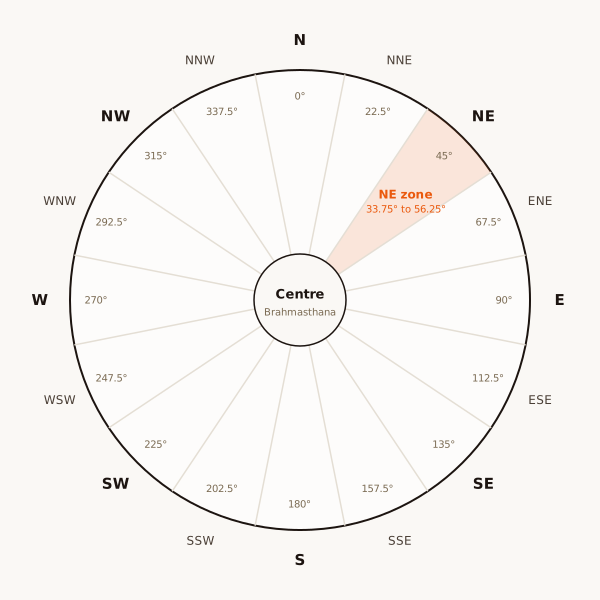
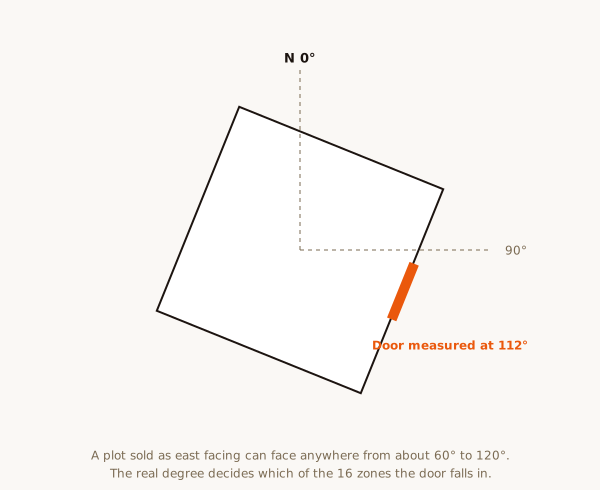
- What we measure: the true-north direction in degrees, the boundaries of the 16 zones (about 22.5 degrees each), where the entrance, kitchen, toilets and bedrooms fall, how light enters, and whether air can cross a room.
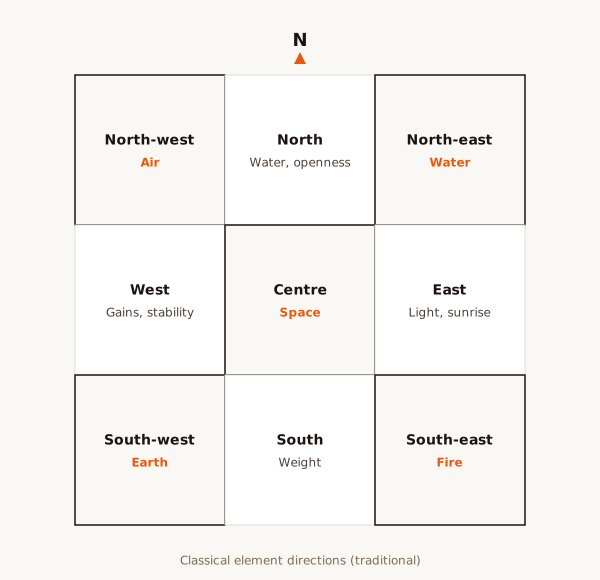
- Traditional guidance: what classical texts such as the Aparajitaprccha and the wider Vishvakarma tradition say each zone suits, for example fire in the South-East and openness in the North-East.
- Interpretive: readings from the Lecher Antenna and the UAS, and any judgement that depends on them.
Keeping the layers apart lets you act on the measured findings with confidence and weigh the interpretive ones for yourself. Our Vastu methodology page explains how the layers fit together in the VIDS™ method, and the guide to the 16 Vastu zones covers the measured grid itself.
Geopathic stress in Geo Vastu
The antenna is mostly used to look for what the Geo Vastu tradition calls geopathic stress. The idea is that certain places, often described as lying above underground water flows, ground fractures or a regular grid of lines known in building biology as the Hartmann and Curry grids, are less comfortable for long periods of sleep or sitting.
Traditional guidance in this school is simple: avoid placing a bed, a study desk or a long-use chair on a marked line or crossing point. It does not ask you to rebuild anything.
We present this as tradition, not as established fact. Mainstream science has not confirmed that these lines exist in the way the tradition describes. Our geopathic stress audit page sets out the service in detail, with the same caveats.
How a Lecher antenna Vastu survey is done, in 6 steps
An antenna survey can only be done in person, so it is part of a site visit, never an online Vastu consultation. A typical home visit takes 2 to 4 hours in total, and the antenna work is done after the measured part is complete. An online assessment uses traditional Vastu only, the 16-zone map and the 3×3 grid drawn on your plan; geopathic stress readings need a site visit.
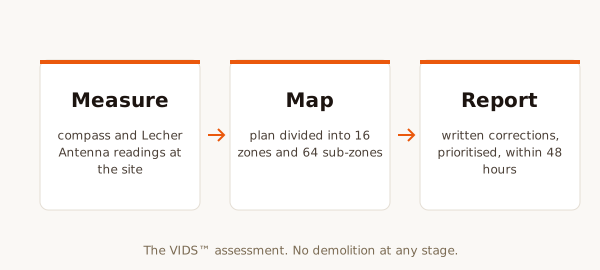
- Measure first. We take compass readings at several points away from steel, magnets and wiring, correct magnetic north to true north using the magnetic declination for the site (the NOAA magnetic declination calculator gives the current value), and draw the 16-zone grid on your plan.
- Listen. We ask which rooms feel uncomfortable, which chair nobody uses and where people prefer not to sit. These are observations, not diagnoses.
- Walk the grid. The practitioner walks each room slowly in parallel passes, starting with beds, desks and long-use seats.
- Mark. Points where the antenna responds are marked temporarily with tape on the floor and copied onto the plan.
- Repeat-check. Crossing points are walked again from a different direction. Only marks that repeat go into the report.
- Record honestly. Findings go into the written report under an Interpretive heading, with a practical suggestion beside each one.
What a reading can tell you
Used carefully, the antenna gives you a few useful things:
- A map, drawn on your own plan, of where an experienced practitioner reads lines and crossing points.
- A clear, free suggestion for each bed, desk or chair that sits on a marked point, usually a small move.
- A reason to try a change and notice for yourself whether the room feels different over the following weeks.
That last point matters. You are the best judge of whether a moved bed feels better, and the change costs nothing to undo. Our guide to Vastu for bedroom placement covers the measured and traditional side of the same decision.
What it cannot tell you
Equally important are the limits:
- It is not a medical test. It cannot diagnose or explain any illness. Anyone with a health concern should see a qualified doctor.
- It cannot predict or improve wealth, marriage, exam results or business success, and we make no such promise.
- It is not a structural, damp, electrical or radon survey. Those need qualified engineers and proper instruments.
- We do not use it to site borewells. That is work for a hydrogeological survey.
- It is never, on its own, a reason to buy, sell, demolish or rebuild.
What we do with the readings
Our corrections follow the same rule as the rest of our Vastu work: no demolition and nothing to buy. In practice that means moving a bed by a short distance so the headboard clears a marked point, turning a desk, swapping two rooms’ uses, or moving a long-use chair. If a room cannot be rearranged, we say so and leave the decision with you.
We do not sell plates, crystals, copper strips, neutralisers or any other product, and we take no commission from anyone who does. If a practitioner’s reading leads straight to a sales pitch, treat that as a warning sign. Our wider approach is set out in zero-demolition Vastu corrections.
Where the UAS fits
The Universal Aura Scanner (UAS) by Geo Engineering is a second radiesthesia-type instrument that Raghavendra Hebbur uses on some visits. It sits in the same interpretive category as the antenna and carries the same caveats. When both instruments point to the same spot, we note it. We do not treat agreement between two dowsing-type readings as scientific confirmation.
When it is worth doing, and when it is not
An antenna survey is most worth adding when:
- You are setting up a new home and deciding where beds and desks will go.
- Someone in the household is interested in this layer and wants it considered.
- We are visiting anyway, so the extra time is small compared with a separate trip.
It is less useful when the bigger measured issues are still open. An entrance, kitchen or toilet in a difficult zone matters more to a layout than any line reading, and those can be assessed remotely through an online Vastu consultation. Our comparison of online and on-site consultations explains what each can cover. If the idea of hidden lines makes you anxious, it is perfectly reasonable to skip this layer altogether.
Questions to ask any practitioner
Whoever you work with, these questions will tell you a lot:
- Will you mark the readings on a plan that I keep?
- Do you re-check crossing points before reporting them?
- Will you tell me which findings are measured and which are interpretive?
- Do you sell anything after the reading, or earn commission from someone who does?
- Do you make any health or wealth claims based on the result?
Clear answers to all five are a good sign. Vague ones are worth noticing, whether the practitioner calls the work Vastu, Geo Vastu or building biology.
Adding the survey to your consultation
If you would like the antenna layer included, mention it when you book a site visit and we will plan the time for it. The Vastu for home page describes the full visit, the sample Vastu report shows how interpretive findings are labelled, and our fees page lists current charges. When you are ready, you can book a consultation.