Veedhi shoola Vastu deals with a road that runs straight at a plot and ends at, or turns sharply in front of, its boundary. In Bangalore this is the familiar T-junction plot, or the house at the end of a cross road where every vehicle drives towards the gate before turning. Classical Vastu calls this a veedhi shoola, literally a road that strikes like a spear.
This Vastu guide explains how tradition classifies road hits by direction, why some are considered acceptable and others are avoided, how we verify a road hit on site, and what can be done with a compound wall, planting and gate position. We present the directional classification honestly, as traditional guidance, and keep it separate from what we actually measure.
What counts as a veedhi shoola
A veedhi shoola exists when the centre line of a road, if extended, runs into your plot. The road may end at your boundary in a T-junction, or it may meet your road at an angle so that traffic points at your gate before it turns. A road that simply runs past the plot, parallel to a boundary, is not a road hit.
The Vastu reading depends on two things: which side of the plot the road hits, and which part of that side. A road hitting the East side near the North-East corner is read very differently in Vastu tradition from one hitting the East side near the South-East corner.
The traditional classification by direction
Traditional Vastu guidance divides each side of the plot into two halves and names eight possible road hits. The reading below is the one most commonly taught. Different schools vary in detail, especially on the two moderate cases, so please read it as classical guidance, not as a measured result.
Considered favourable in Vastu tradition:
- East of North-East: a road from the East hitting the northern half of the East side.
- North of North-East: a road from the North hitting the eastern half of the North side.
Often treated as acceptable or moderate:
- South of South-East: a road from the South hitting the eastern half of the South side.
- West of North-West: a road from the West hitting the northern half of the West side.
Traditionally avoided:
- East of South-East: a road from the East hitting the southern half of the East side.
- North of North-West: a road from the North hitting the western half of the North side.
- South of South-West: a road from the South hitting the western half of the South side.
- West of South-West: a road from the West hitting the southern half of the West side.
The pattern follows the wider Vastu logic: roads that bring movement towards the North-East are welcomed, and roads that push towards the South-West, the corner tradition wants closed and stable, are avoided.
Why tradition cares about road hits
Classical Vastu texts treat a road as a channel of movement and force. A road that runs at a plot directs that movement into one part of the site. Whether that is welcome depends on which part receives it.
There is also a plain practical side that needs no tradition at all. A plot at the end of a road takes the headlights of every car at night, the dust and noise of traffic braking and turning, and a real risk from a vehicle that fails to turn. Rainwater running down a sloping road can also flow straight towards the gate. We include these practical points in every veedhi shoola Vastu reading because they affect daily life whatever one’s view of tradition.
How we verify a road hit on site
What we measure: a road map or a builder’s layout is not enough. Road names and the side called the front are often several degrees away from the true directions. On site we take the true north with a compass, corrected for magnetic declination using the NOAA magnetic declination calculator.
We then mark:
- The centre line of the approaching road, extended to the plot boundary.
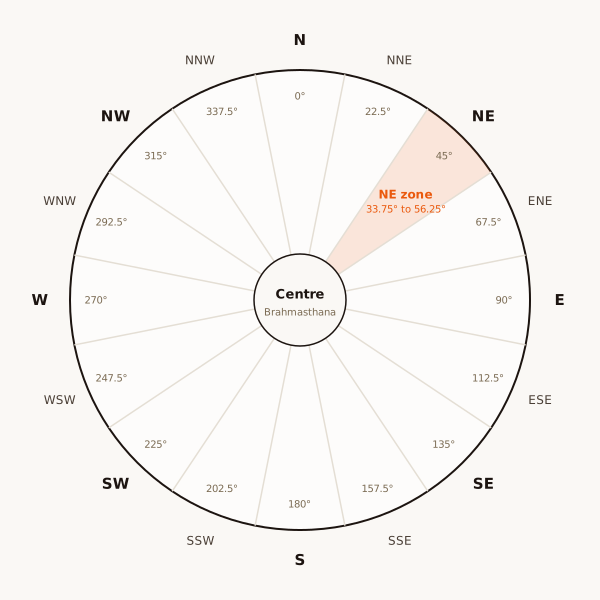
- The exact point where that line meets the boundary, and which of the 16 zones of about 22.5 degrees it falls in.
- The width of the approaching road and how far it runs straight before reaching you.
- Whether the road slopes towards or away from the plot, and where its stormwater goes.
- The gate position and the main door position relative to that line.
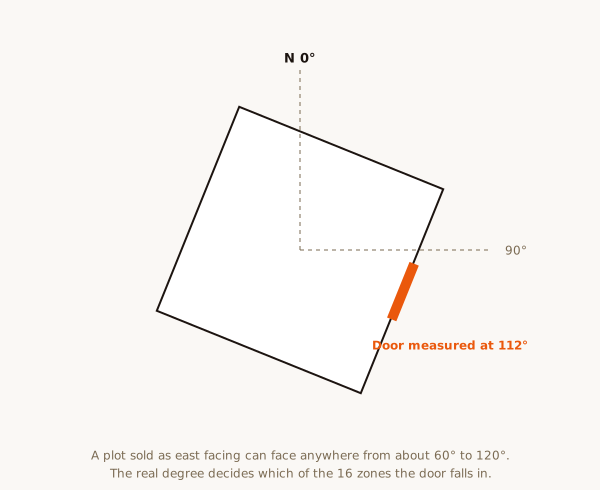
A road that looks as if it hits the North-East on a brochure may actually land in the East or East-North-East zone once the plot tilt is measured. Our guide to plot facing direction explains how a few degrees of tilt change the reading.
Partial hits, wide roads and dead ends
Not every road hit is equal. A narrow lane that ends at your boundary carries far less traffic than a main road that turns at your gate. A road that meets your plot at an angle, rather than straight on, is generally read as a weaker hit in Vastu practice.
We also look at whether the road hits the plot itself or only a neighbour’s compound wall beside you, whether there is a park, a median or a building between the road end and your boundary, and whether the road is likely to be widened. A dead end with a turning circle in front of the plot is a different case from a through road that bends.
Corrections without demolition
Most veedhi shoola corrections work at the boundary, before the force of the road reaches the house. None of them involve breaking the house, and we sell no products for any of them.
- Solid compound wall: where a road hit falls in an unfavourable zone, build or keep that part of the compound wall solid and a little higher, rather than open grillwork.
- Planting: a row of dense hedge or trees inside the wall where the road meets it absorbs headlights, dust and noise and softens the line of the road.
- Gate position: move the gate away from the line of the road where the hit is unfavourable, ideally to a better zone of the same side. A gate shift is a modest civil job, not demolition.
- Main door: keep the main door out of the direct line of an unfavourable hit. Where it is already in line, a planted screen or a covered porch between gate and door breaks the straight path.
- Driveway and drainage: grade the entrance so road water does not run into the plot, and give the driveway a slight turn rather than a straight run from the gate to the door.
Where a road hit falls in a favourable zone, such as East of North-East, we usually advise the opposite: keep that part open, place the gate there, and avoid blocking it with heavy structures.
What these corrections can and cannot do
A compound wall, hedge and gate shift change how the road meets your plot and reduce the practical nuisance of traffic. They do not remove the road, and we make no promise about wealth, health, marriage or any other life outcome from any Vastu correction. Layout can manage movement, privacy and light. It cannot guarantee results.
Where a road hit is strong and falls in a traditionally avoided zone, we say so plainly in the report, together with what the boundary corrections can reasonably achieve. More examples of boundary and placement corrections are in our zero demolition Vastu corrections guide.
Veedhi shoola Vastu in apartments and gated layouts
In an apartment, the road hit applies to the building, not to your flat, and you cannot move the gate or the compound wall. We note the road hit in an apartment Vastu reading, but the focus stays on what you can change inside your own home.
In gated villa layouts, internal roads often create T-junction plots inside the community. These internal roads usually carry much lighter traffic than public roads, so the practical impact is smaller, though the traditional classification is applied in the same way.
Buying advice for T-junction plots
T-junction plots are often priced differently, so buyers ask us whether the difference is worth it. Our honest view:
- A plot with a road hit East of North-East or North of North-East is generally acceptable in Vastu tradition, and many buyers prefer it.
- A plot with a South of South-West or West of South-West hit is the one tradition warns against most. If you have a choice, we usually advise another plot.
- An East of South-East or North of North-West hit sits in between in practice; we look at road width, traffic and the room for a solid wall and planting before advising.
- Any plot facing a busy main road end has a real safety question, separate from Vastu. Check traffic at peak hours and at night before deciding.
Our before buying a plot checklist covers the other points we check, including slope, shape and neighbouring structures.
Planning a new house on a road hit plot
If you already own a plot with a road hit, plan the house around it from the start. Set the gate and main door away from the line of an unfavourable road, keep a deeper front setback and a planted buffer on that side, and put service areas rather than bedrooms nearest the road end. Our Vastu for new construction service works with your architect at the drawing stage.
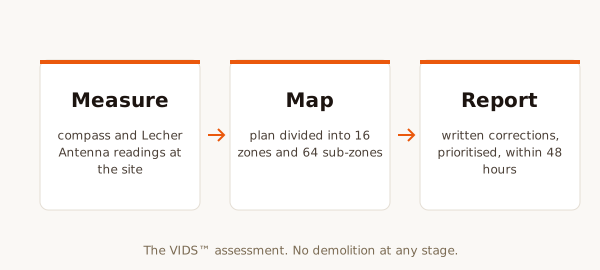
Getting a plot checked before you buy
Veedhi shoola is one of the first things we read in a plot assessment, along with shape, slope and facing. Our Vastu for plot service includes a pre-purchase plot report for ₹5,000, and our Vastu methodology page explains how the 16-zone reading works. You receive a written report within 48 hours, and you can book a Vastu consultation whenever the timing suits your purchase.