Plot shape Vastu is the first check we make on any land, because the shape of a plot decides how well a house can be planned on it by direction. Classical texts prefer square and rectangular plots, read cut and extended corners carefully, and pay close attention to which way the land slopes. Shape and slope are also the two things you cannot change after you buy, which makes them worth checking before you sign.
This guide covers the shapes tradition prefers and avoids, how to read irregular plots and corner cuts, what slope and level mean, and how an awkward plot can often be made to work without fighting the land. As always, we separate traditional guidance from what we measure on site.
Why shape matters
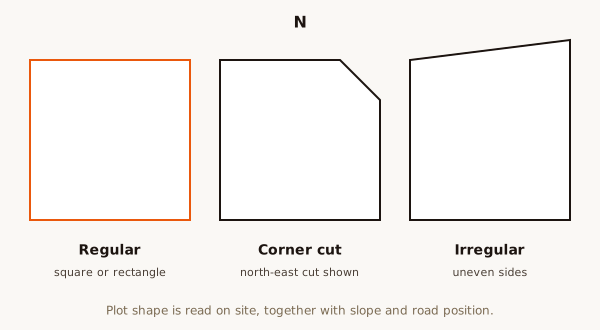
Classical planning starts with the Vastu Purusha Mandala, a square grid laid over the site. The closer the plot is to a square or a regular rectangle, the more cleanly the grid sits on it and the easier it is to place rooms in their traditional zones. Missing corners take away part of the grid; extra corners add parts that do not belong to it.
There is also a plain practical reason. Regular plots give regular buildings, which are cheaper to build, easier to ventilate and simpler to furnish. Many of the shape preferences in the tradition line up with common sense about construction.
Square and rectangular plots
A square plot is the classical ideal. A rectangle is equally accepted, as long as it is not too elongated: a length up to about twice the width is generally treated as good, and many practitioners prefer the longer side running east to west or north to south depending on the use.
Standard Bangalore site sizes such as 30×40, 30×50, 40×60 and 50×80 are all regular rectangles and sit well in classical terms. For house planning on these sizes, see 30×40 house plan Vastu.
Gaumukhi and sherdaha plots
Tradition names two tapering shapes. A gaumukhi plot, shaped like a cow face, is narrower at the front and wider at the back. It is traditionally considered good for homes. A sherdaha or simhamukhi plot, shaped like a lion face, is wider at the front and narrower at the back. It is traditionally preferred for shops and commercial buildings, where a wide frontage matters.
What we measure: the exact widths at front and back, which sides are road-facing, and how much the taper affects the building footprint. A small taper often makes little difference once setbacks are applied.
Irregular plots: triangles, L-shapes and more
Traditional guidance is cautious about triangular, circular, L-shaped and many-sided plots, because the grid cannot sit on them cleanly. A triangle is the shape tradition most strongly avoids for a home.
Irregular plots are not always a reason to walk away. Often the useful part of the plot is a regular rectangle, and the odd remainder can be separated with the compound wall, planted as garden, or used for parking. The house is then planned on the regular part. We mark this on the site plan so your architect can see exactly where the regular footprint lies.
Cut and extended corners
A cut corner is a missing corner of the plot; an extension is a corner that juts out. Tradition reads them by direction:
- A cut in the north-east is the one tradition most dislikes.
- A cut in the south-west is also a concern, since that corner should be strong.
- An extension in the north-east is traditionally welcome, especially along the north or east side.
- Extensions in the south-west, south-east and north-west are generally treated with caution.
See cut corner Vastu for how each case is read and handled.
Slope and level
Tradition prefers land that is highest in the south-west and falls gently towards the north, east or north-east. Rainwater then drains away from the house towards the side where the sump and borewell usually sit. Land that falls towards the south-west is the slope tradition most dislikes.
What we measure: the actual fall across the plot with a level, not by eye, and the level of the road and neighbouring plots. A slope can often be corrected during construction by filling and grading, which is common practice and does not count as demolition. The built floor level is what matters most in the end.
Surroundings and roads
Shape is read together with what surrounds the plot. Roads on the north and east are traditionally preferred. A road that runs straight into the plot boundary, called a road hit, is read by the zone it meets; see veedhi shoola Vastu. Tall buildings close to the north and east, or a large water body to the south-west, are noted as traditional concerns.
Our guide to which direction a plot should face covers facing and roads in more detail.
Plot orientation and tilt
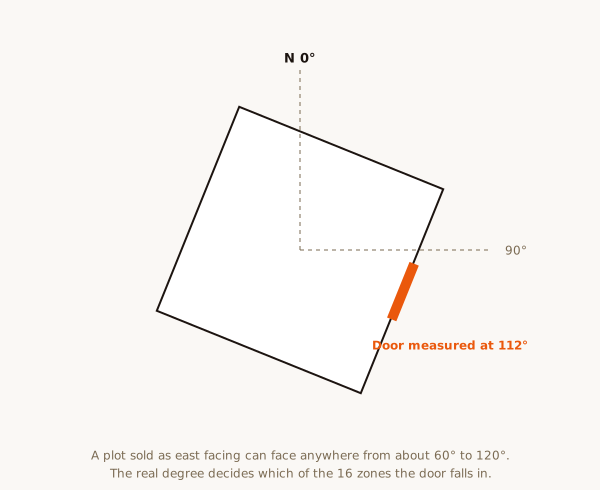
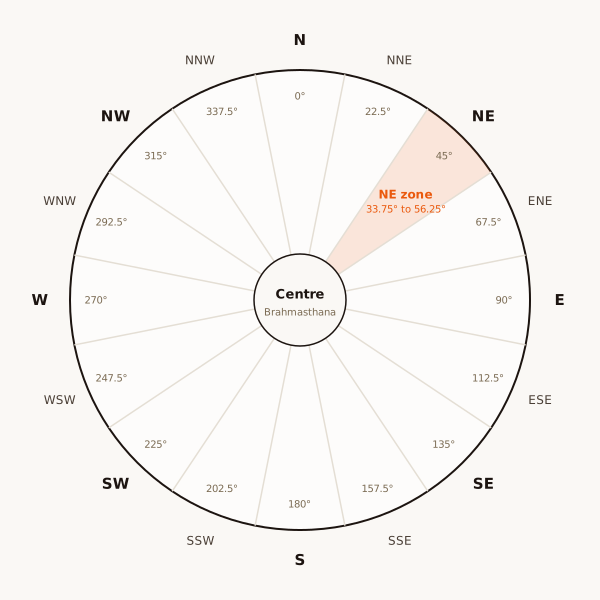
Many layouts are not aligned exactly to the cardinal directions. A plot tilted by a few degrees is read normally, while a tilt of around 45 degrees makes it a diagonal plot whose sides face the corner directions. We fix true north on site with a compass corrected for declination, which you can check with the NOAA magnetic declination calculator, and measure the tilt precisely.
How we assess a plot
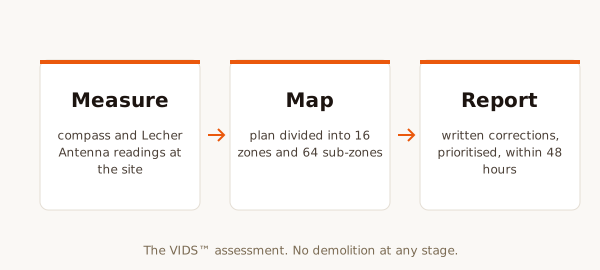
On site we measure the boundaries, corners, tilt and slope, mark roads and surroundings, and draw the 16-zone map and grid over the survey. For land outside Bangalore, we can review the survey sketch online with guided compass readings. The written report, delivered within 48 hours, states whether the plot suits a home or business, which parts to build on, and what to check with your architect. A pre-purchase plot report costs ₹5,000.
See Vastu for plot and our plot buying checklist.
Plot shape Vastu for commercial and industrial land
Commercial plots are read with the same plot shape Vastu principles, with a few differences in emphasis. A wide road frontage is valued for shops and showrooms, which is why the tapering sherdaha shape is traditionally accepted for business use. For offices, a regular rectangle with the longer side along the road gives the most flexible floor plates.
Industrial plots are usually larger and often irregular, with sheds, yards and services spread across the land. Vastu reads the plot as a whole first, then each building on it. Heavy sheds and raw material stores suit the south-west, the boiler and transformer the south-east, and finished goods and dispatch the north-west. See industrial plot Vastu for how we assess factory land.
Agricultural land and farmhouse plots
Farmland rarely comes in tidy rectangles. For a farmhouse or weekend home, Vastu guidance focuses on the house plot within the larger land: choose a regular area, ideally on ground that falls towards the north or east, and plan the house, well or borewell and gate within it. The rest of the land can follow its natural shape.
Large trees suit the south and west of the house plot, while the north-east is kept open. See Vastu for farmhouses and weekend homes.
What plot shape Vastu cannot change
Shape and slope set the frame for everything else, but they are not the whole reading. A well-shaped plot can still carry a poorly planned house, and an awkward plot can carry a very good one. We do not tell anyone that a plot will bring good or bad fortune. We say how well it suits a house or business by classical Vastu guidance, what can be corrected during construction, and what cannot.
If a plot has a serious issue, such as a large cut in the north-east or a strong fall towards the south-west, we say so plainly before you buy rather than after.
A quick plot shape checklist
Before a site visit or a purchase, these questions give a fast first reading:
- Is the plot a square or a rectangle no longer than about twice its width?
- Are any corners cut, and if so which ones?
- Does any corner extend, and in which direction?
- Which way does the ground fall, and where does rainwater go?
- Which sides face roads, and does any road run straight into the boundary?
- Is the plot tilted from the cardinal directions, and by how many degrees?
- What stands on the north, east, south and west boundaries?
Write the answers down with photographs and the survey sketch. They are exactly what we need for an online plot reading, and they make an on-site visit faster.
Your next step
If you are about to buy land, a short reading of shape, slope and roads can save a great deal later. Book a consultation and receive a measured, written report within 48 hours.