Short answer: Vastu before buying a house or resale villa focuses on the permanent, immovable civil features that you cannot change after purchase: the true facing degrees, compound gate and entrance padas, plot shape, soil gradient, existing underground borewell, sump location, overhead tank, septic tank, and internal or external staircase. Unlike an apartment where you only manage internal drywall, an independent house controls its own land. An existing borewell or water sump in the South-West is a major structural defect; placing it in the North-East is ideal. A formal pre-purchase Vastu check costs ₹10,000 and delivers a written diagnostic report within 48 hours before you pay the booking advance.
Buying an independent house, gated community villa, or resale property is usually the largest financial investment a family will make. When purchasing a standalone house, you are not simply acquiring a floor plan: you are acquiring the underlying plot, the boundary setbacks, the drainage slopes, the existing utility connections, and years of structural alterations made by previous owners.
Most homeowners contact a Vastu consultant only after registering the property, taking possession, and discovering that a staircase or toilet sits in an awkward zone. While zero-demolition spatial corrections can balance almost any existing room, evaluating a house before you pay the booking deposit gives you the power to choose. This guide outlines 14 essential Vastu checks for independent houses, how to audit resale villas, and what can and cannot be corrected later.
Why independent houses differ from apartments in Vastu
In a multi-storey apartment, the land, building foundations, borewell, and overhead tanks are shared common infrastructure managed by the resident welfare association. Your personal Vastu boundary begins and ends at the four walls of your individual flat.
In an independent house or villa, however, the homeowner owns both the physical building and the ground beneath it. This introduces a double layer of Vastu influence:
- The Macro Layer (The Plot): Shape of the perimeter, slope of the soil, placement of the underground borewell, stormwater runoff, boundary gate pada, and relationship to surrounding access roads.
- The Micro Layer (The Built Structure): Placement of rooms, staircases, kitchen, bathrooms, puja room, and terrace tanks.
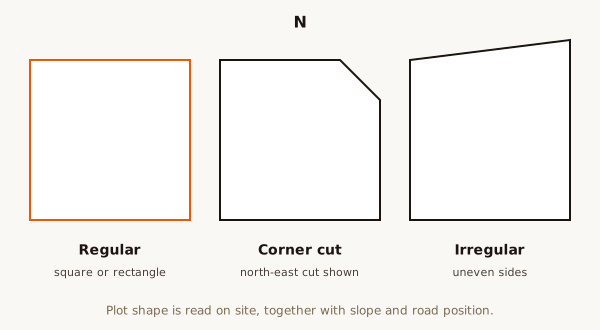
If an independent house has an auspicious internal floor plan but sits on a plot with a severe road hit or an underground borewell in the South-West, the property will still experience energetic drag. That is why pre-purchase due diligence for houses must inspect the outdoor civil infrastructure first.
For a detailed look at plot geometry, read: Vastu for Plot and Land.
14 essential Vastu checks before buying an independent house
Before you hand over a non-refundable booking deposit or sign a legal sale agreement for a resale villa or newly constructed house, systematically evaluate these 14 checkpoints:
Check 1: True north bearing and plot tilt
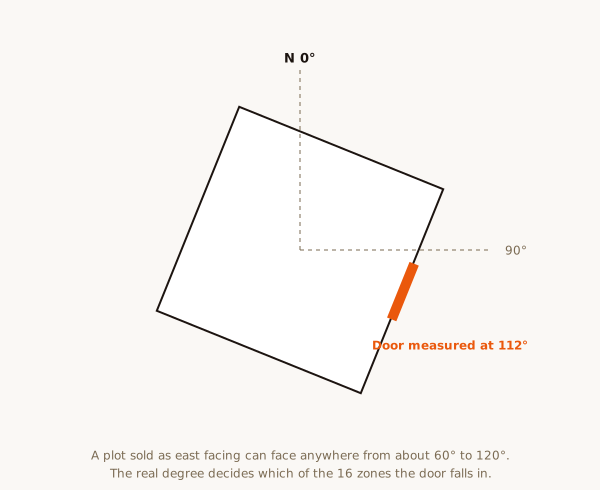
Never accept the printed north arrow on a sale deed or layout brochure without verification. Builders often draw north arrows perpendicular to the road for graphic convenience.
Take compass readings along the compound wall and correct for local magnetic declination using the NOAA magnetic declination calculator. If a house is sold as “East facing” but its axis is tilted 20 degrees clockwise, the main door may actually fall in East-South-East (ESE) or South-East (SE), completely altering its Vastu classification.
Check 2: Compound gate pada vs front door pada
On an independent property, there are two distinct entrance portals: the compound gate in the boundary wall, and the main front door of the built house. They do not have to sit on the same line, but both should fall in auspicious padas:
- Favoured Gate and Door Padas: N3 to N5 on the North; E3 and E4 on the East; S3 and S4 on the South; and W3 and W4 on the West.
- Common Mistake: In many resale houses, previous owners placed the car gate in the extreme South-West corner (padas S6 to S8) to maximize lawn space. A gate in the South-West destabilizes family authority and financial security.
For the complete 32-pada degree chart, explore: 32 Entrances Vastu with Degrees Chart.
Check 3: Underground water sump and borewell location
Water beneath the earth represents the Water element (Jal Tatva). Its placement is one of the most critical factors in an independent house:
- Ideal Placement: The North-East (Ishanya, 33.75° to 56.25°), North, or East setback. A clean underground freshwater sump or borewell here enhances mental peace, clear thinking, and liquidity.
- Critical Red Flag: An underground sump or borewell in the South-West (Nairutya). The South-West represents the Earth element and requires maximum structural weight and density. Digging a deep water cavity in the South-West hollows out the foundation, linked in classical treatises to chronic financial leakage and health complications.
Learn more in: Water Tank and Sump Vastu.
Check 4: Septic tank and sewage inspection chambers
In independent villas without underground municipal sewerage connections, a septic tank is installed within the plot setbacks:
- Recommended Zones: South-South-West (SSW, 191.25° to 213.75°, the zone of disposal) or West-North-West (WNW).
- Strict Prohibitions: A septic tank must never sit in the North-East (which pollutes the sacred water quadrant), South-East (fire clash), or South-West. Ensure the septic tank does not directly touch the foundation wall of the house.
Explore our detailed guide: Septic Tank Vastu.
Check 5: Overhead water tank on the terrace
While underground water belongs in the North-East, elevated water on the rooftop terrace belongs in the South-West or West:
- Ideal Placement: South-West (Nairutya) corner of the highest terrace slab. Its substantial physical tonnage provides essential grounding ballast to the stability quadrant.
- Strict Prohibitions: Never buy a house where the overhead Sintex or concrete water tank is positioned directly above the North-East corner of the terrace. This places crushing downward weight on Ishanya, causing heavy headaches and blocked career opportunities.
Check 6: Internal and external staircases
Staircases represent physical mass, vertical movement, and structural weight:
- Recommended Zones: South, West, or South-West. The flight of stairs should ascend in a clockwise direction.
- Strict Prohibitions: A staircase rising directly in the Brahmasthan (the exact center of the ground floor) or in the North-East corner. A central staircase pierces the navel of the house, causing continuous restlessness. An external spiral staircase in the North-East blocks morning sun.
Read our full guide: Staircase Vastu (Internal and External).
Check 7: Natural slope, gradient and drainage levels
Inspect the natural topography of the land before any cosmetic landscaping is done:
- Beneficial Gradient: The plot and surrounding street should naturally slope gently downwards from South-West towards North-East. Rainwater and surface runoff should flow towards the North or East.
- Challenging Gradient: A plot that slopes downwards towards the South or West, leaving the North-East elevated and dry. This requires retaining walls and grading adjustments to rebalance levels.
Check 8: Boundary walls and compound setbacks
In classical Vastu architecture, boundary walls manage environmental and thermal exposure:
- Wall Heights: The southern and western compound walls should be constructed thicker and slightly higher than the northern and eastern boundary walls. This shades the property from harsh afternoon heat while inviting morning light.
- Setback Proportions: The open setbacks along the North and East of the house should be wider and more open than the setbacks on the South and West. Avoid houses pushed entirely against the north boundary wall.
See our guide: Compound Wall Vastu.
Check 9: Road hits and T-junctions (Veedhi Shoola)
When inspecting corner plots or houses located at street intersections, verify whether an incoming road points directly at the property:
- Beneficial Road Hits: Roads striking the North-East from the North or East are considered auspicious in classical texts.
- Severe Road Hits: A perpendicular road pointing directly into the South-West corner (from South or West) or South-East corner directs high-speed vehicular energy straight into the property, requiring defensive shielding and landscaping.
Read: Veedhi Shoola Vastu (Road Hits and T-Junctions).
Check 10: Kitchen and cooking stove placement
Verify the position of the kitchen on the ground floor or main living level:
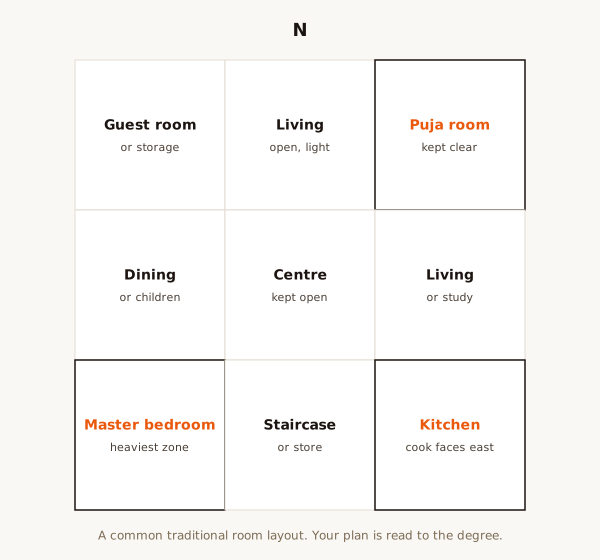
- Ideal Zone: South-East (Agneya, 123.75° to 146.25°), the home of the fire element. The secondary acceptable zone is North-West (Vayavya).
- Cook Facing: The platform should allow the cook to face East while preparing food. Avoid kitchens located in the North-East or South-West.
Check 11: Master bedroom stability in the South-West
In independent villas, the primary master bedroom should be situated in the South-West (Nairutya) sector, preferably on the upper floor:
- Upper Floor Advantage: In multi-level villas, having the master bedroom on the highest floor in the South-West adds grounding authority to the head of the household.
- Bed Alignment: Ensure the room allows the bed headboard to be placed against the South or West wall, so occupants sleep with their head pointing South or East.
Check 12: Previous structural additions and cantilevers
In resale houses, previous owners often enclose verandas, build temporary shed roofs, or cantilever additional rooms over setbacks:
- Cantilevers in South-West: If an upper-floor bedroom juts out heavily over an open ground-floor car porch in the South-West, it creates a “floating Nairutya”, meaning the master bedroom rests on thin air rather than solid ground.
- Asymmetrical Extensions: Ensure unauthorized rear shed additions have not created severe missing corners or irregular jagged projections.
Check 13: Electrical transformers and street fixtures
Stand at the front gate and look across the street:
- Avoid Direct Obstacles: Ensure there is no high-voltage electrical distribution transformer, massive street tree trunk, or sewer manhole positioned directly in front of the main entrance gate. Street obstacles in line with the doorway obstruct energy entry.
- High-Tension Power Lines: Avoid houses directly underneath or immediately adjacent to high-tension overhead transmission lines, which emit continuous electromagnetic radiation detectable during geopathic audits.
Check 14: Neighbouring shadows and surroundings
Examine the neighbouring properties:
- Elevation Balance: If a neighbouring house to the South or West is taller and heavier, that is acceptable as it shields afternoon heat. However, if a massive high-rise tower to the North or East completely blocks morning sun and sky views, it creates a continuous shadow over the intake quadrant.
- Religious and Commercial Structures: Check that the property does not share a direct common wall with a temple, cemetery, or hospital morgue.
Comparing two or three properties side by side
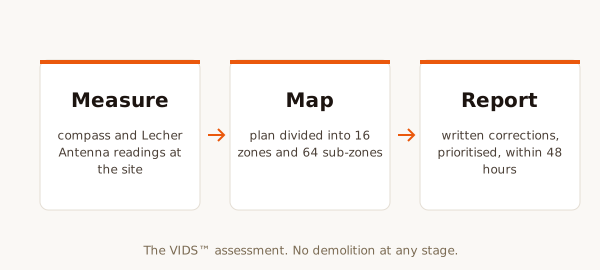
Homebuyers are rarely deciding on a house in isolation: they are choosing between two or three options in different gated communities or neighbourhoods. Our pre-purchase audit evaluates all shortlisted properties on an identical 16-zone scorecard:
| Feature | Property A (East Villa) | Property B (South Villa) | Property C (North Villa) |
|---|---|---|---|
| Orientation & Tilt | East +12° (Favoured) | South +4° (Favoured S4) | North -18° (Tilted) |
| Main Door Pada | E4 Mahendra (Favoured) | S4 Grihakshata (Favoured) | N1 Roga (Avoided) |
| Borewell / Sump | North-East (Favoured) | North (Favoured) | South-West (Critical Defect) |
| Kitchen Zone | South-East (Ideal) | South-East (Ideal) | North-West (Acceptable) |
| Master Bedroom | South-West (Ideal) | South-West (Ideal) | South-East (Restless) |
| Staircase Location | South (Clockwise) | West (Clockwise) | Centre / Brahmasthan (Defect) |
| Overall Verdict | Top Choice (Clean) | Strong Choice (Easily Balanced) | Avoid (Heavy Civil Rework) |
What can be corrected later vs what is fixed forever
Before you pay your deposit, separate what can be balanced through non-demolition remedies from what is permanent:
- Permanent / Hard to Change: Plot shape, road hits, surrounding buildings, underground borewell in South-West, heavy central concrete staircase.
- Changeable Without Demolition: Room usage, bed alignment, desk facing, wall colours, threshold metallic strips, lighting, and interior furniture layouts.
Read: Zero-Demolition Vastu Corrections.
Fees and booking your pre-purchase dossier
Our pre-purchase consultation service gives you total peace of mind before signing:
- Pre-purchase plot, house or villa check: Flat ₹10,000 (online worldwide or on-site in Bangalore; written report delivered within 48 hours).
- Independent house / villa on-site audit (after purchase): ₹25,000 in Bangalore.
- Outstation villa consultation: ₹30,000 plus actual travel expenses.
View full fee schedules on our Vastu consultation fees page.
Next step
If you are about to pay a token advance on an independent house or villa, send us the floor plan, site drawing, and Google Maps pin on WhatsApp at +91 97391 05574 today. Tell us your decision deadline, and Raghavendra Hebbur will provide an objective, mathematical 16-zone assessment before you commit your capital.