Compound wall Vastu covers the boundary of a plot: how high and solid each side should be, where the gate goes, how the wall handles cut corners and road hits, and what belongs in the open space between the wall and the house. It is one of the few parts of a property that can often be rebuilt without touching the house, which makes it a useful tool for an independent house, a villa or a factory.
This guide sets out the traditional guidance for each side, gate positions, common problems and how we assess a boundary on site. We keep what we measure separate from what tradition says, and we always work within local building rules.
Why the boundary matters in tradition
Classical texts treat the compound wall as the outer edge of the planning grid. It defines the shape of the site that the Vastu Purusha Mandala is laid over, so a wall that squares off an irregular plot can effectively give the house a regular site. The wall also sets the open space around the building, which tradition wants larger on the north and east.
In practical terms the wall controls privacy, security, noise and the sun and wind that reach the ground floor. Much of the traditional guidance lines up with these plain functions.
Height and thickness by direction
- South and west: higher and more solid. These sides face the hottest afternoon sun in Bangalore, and tradition wants them strong.
- North and east: lower or lighter, with open grillwork where privacy allows. These sides welcome morning light.
- South-west corner: the highest and most solid point of the boundary.
- North-east corner: the lowest and most open point.
Local rules limit wall heights, so the difference may be modest. Even a small difference in height, or solid panels on the south and west with grilles on the north and east, follows the principle.
Gate position: the 32 padas
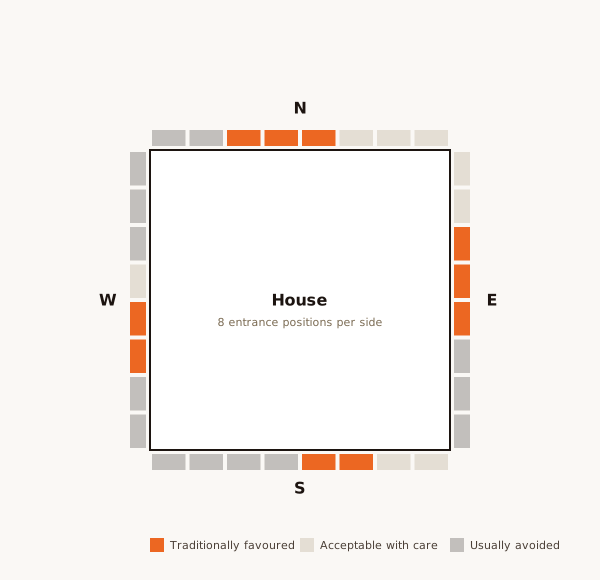
The gate is read on the boundary wall in the same way as the main door is read on the house, by dividing the road-facing side into eight padas. Favourable positions exist on every side, including the south and west. See 32 entrances Vastu for how the padas are counted and which are favoured.
The gate and the house door are separate readings. They do not have to line up, and on many plots it is better that they do not, so that the path from gate to door turns gently rather than running straight.
Gate details
- Two leaves opening inwards are traditionally preferred.
- The gate should open fully and smoothly without catching.
- A gate wider than the house door suits tradition.
- Avoid a gate placed exactly at a corner of the plot.
- Keep the gate area clean, lit and free of stored material.
- For a separate pedestrian gate, read it on its own pada.
Cut corners and irregular plots
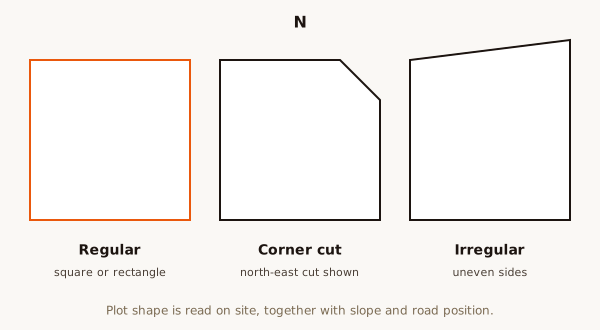
An irregular plot can often be made to read as a regular one by the line of the compound wall. Where a corner is missing, the wall can follow the full rectangle on the inside, leaving the odd piece outside as garden or parking, or the wall can enclose the regular part and leave the rest separate. Where a corner extends, the extension can sometimes be separated by an internal wall.
These choices are best made before construction. See cut corner Vastu and plot shape Vastu.
Road hits and the boundary
When a road runs straight into a plot, tradition reads the effect by the zone it meets. A solid section of compound wall at that point, dense planting inside it and a gate shifted away from the line of the road are the classical responses. They do not remove the road, but they change what the house sees and hears from it.
See veedhi shoola Vastu for which road hits tradition accepts and which it avoids.
What goes in the open space
- Sump and borewell in the north-east of the open space.
- Lawn and low planting in the north and east.
- Large trees in the south and west, at a distance from the house.
- Parking in the north-west or south-east, depending on the facing.
- Generator, transformer or meter board in the south-east.
- Septic tank away from the north-east; tradition often suggests the north-west.
See water tank and sump Vastu and car parking Vastu.
Common problems we see
- A boundary built tall on the north and east and low on the south and west.
- The gate exactly at a corner of the plot.
- A wall that follows a cut corner, leaving the house on an irregular site.
- The neighbour wall on one side treated as the boundary, with no wall of your own.
- Heavy material, sand or scrap stored against the north-east corner.
How we assess a boundary
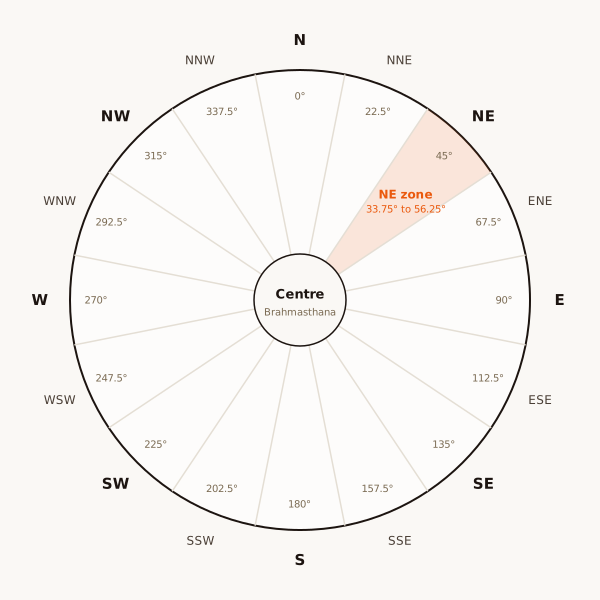
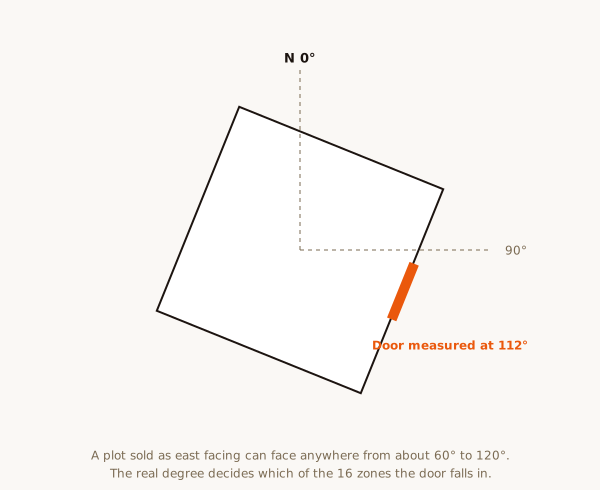
On site, we fix true north with a compass corrected for declination, which you can check with the NOAA magnetic declination calculator, measure the boundary and its corners, mark roads and road hits, and read the gate pada on each road-facing side. The written report arrives within 48 hours and includes the boundary, the open space and the house together.
For a full assessment of a house, see independent house Vastu; for land, Vastu for plot; for factories, industrial plot Vastu.
Materials, colour and finish
Tradition says little about specific materials, but the principle of weight applies. Solid masonry or stone suits the south and west, and lighter grilles or railings suit the north and east. Colour follows the same logic: earthy, warmer tones on the south and west faces, lighter tones on the north and east. See Vastu colours for home.
Keep the wall in good repair. A boundary with cracks, gaps or a sagging gate is noted in a Vastu reading simply because a neglected edge is the first thing a visitor sees and the first place water and dirt collect.
Rebuilding a wall without touching the house
Of all the changes a house owner can make, the compound wall is one of the most practical. It can be raised on the south and west, lowered or opened up on the north and east, and the gate can be moved to a better pada, all without any work on the house itself. For an independent house where the layout inside cannot change, this is often the single most useful correction available.
If you are planning to rebuild, check the local rules on height and setbacks first, then mark the gate pada with a measured reading before the foundation for the gate pillars is dug. Moving a gate later costs far more than placing it well the first time. See our approach to remedies without demolition.
Compound wall Vastu for factories and commercial plots
On industrial and commercial land the boundary does more work: it separates vehicle gates from staff entrances, encloses yards and stores, and often runs along two or three roads. Compound wall Vastu for these sites reads the main vehicle gate and the staff gate on their own padas, keeps heavy stores and the highest wall in the south-west, and keeps the north-east of the yard open, with water storage there if possible.
Security cabins usually sit beside the main gate. Where the gate is on the north or east, tradition prefers the cabin on the side away from the north-east corner. See factory Vastu and warehouse Vastu.
Villas in gated communities and row houses
In a gated community, the boundary of the whole layout belongs to the association, and you cannot change it. What you can read is the boundary of your own villa plot: the low wall or hedge between your plot and the road, the position of your gate, and the open space around your house. The same principles apply on a smaller scale.
Row houses often share side walls with neighbours, so only the front and rear boundaries are your own. We read the front gate on its pada and look at whether the rear open space sits in the north or east, which tradition prefers. See Vastu for villa and Vastu for builder projects.
Hedges and planting count as part of the boundary in a reading. A dense hedge on the south and west and a low, open edge on the north and east follow compound wall Vastu even where no masonry wall is allowed.
Your next step
If you are building or rebuilding a compound wall, the gate position and wall heights are quick to settle on paper. Book a consultation and receive a measured, written report within 48 hours.