Toilet direction Vastu is the most common worry we hear from flat owners, because almost every 2BHK and 3BHK has at least one toilet in a zone that tradition does not prefer. This guide reads all 16 zones one by one, says which are generally avoided, which are generally accepted and which depend on the plan, and explains what can be done without breaking anything.
One honest point first. The classical texts were written long before indoor toilets existed, so they do not list toilet zones directly. What practitioners use today is an extension of the classical principles: keep the north-east clean and light, keep the centre open, keep the south-west stable, and place waste and drainage where it does not disturb those zones. We present the zone guidance on that basis and note where practitioners differ.
How we read a toilet
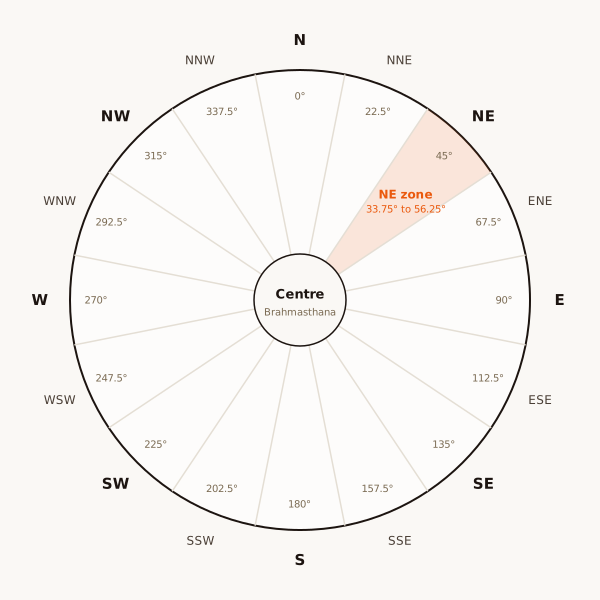
We read a toilet by the zone that holds most of its floor area, measured from the centre of the house or flat and from true north. A phone compass shows magnetic north, so readings are corrected for local declination, which you can check with the NOAA magnetic declination calculator.
A toilet that sits across a zone boundary is read by both zones, and one near the edge of a zone reads very differently from one in its middle. That is why we never judge a toilet from a sketch alone. Our guide to the 16 Vastu zones explains the zone system, and Vastu for toilet and bathroom covers fittings and layout inside the room.
Zones generally avoided
- North-East (NE): the zone tradition most wants clean, light and open, and the one most strongly avoided for a toilet.
- North of North-East (NNE) and East of North-East (ENE): both sit beside the north-east and are generally avoided for the same reason.
- Centre (Brahmasthan): tradition keeps the centre open and clean. See Brahmasthan Vastu.
- South-West (SW): the zone of earth and stability, where tradition prefers weight and the master bedroom rather than drainage.
- North (N) and East (E): generally discouraged, as these are open, light directions in the classical scheme, though some practitioners accept them with care.
Zones generally accepted
- East of South-East (ESE): one of the zones most often recommended for a toilet.
- South of South-West (SSW): widely accepted, and common in Bangalore flats.
- West of North-West (WNW): widely accepted, and often the zone of the common toilet in apartments.
- West (W) and North-West (NW): generally accepted, with the north-west suiting movement and drainage.
- West of South-West (WSW): accepted by many practitioners.
If a toilet sits in one of these zones, there is usually nothing to correct beyond good ventilation and maintenance.
Zones that depend on the plan
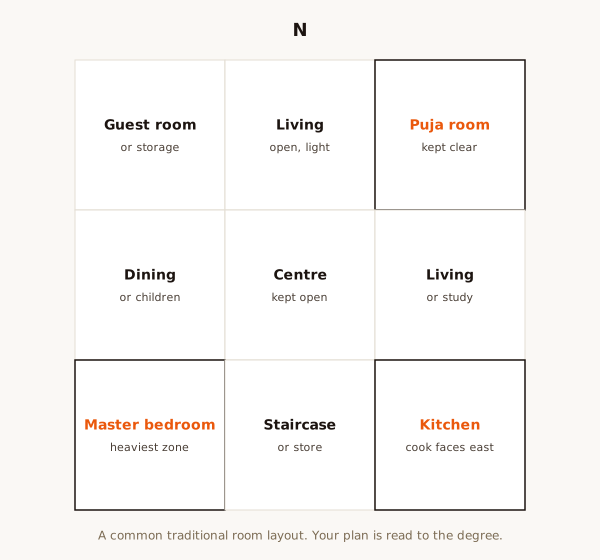
- South-East (SE): the fire zone. Some practitioners avoid toilets here because fire and water are kept apart; others accept the zone if the kitchen is elsewhere.
- South of South-East (SSE): accepted by some, avoided by others, and read with the kitchen position.
- South (S): accepted in many readings, especially away from the south-west corner.
- North of North-West (NNW): accepted by some practitioners, read with the bedroom positions around it.
For these zones we look at the rest of the plan before saying anything, and we tell you where opinion varies rather than presenting one view as certain.
Toilets in apartments
In a flat, toilets are stacked one above the other through the building, so they cannot move. We read each toilet in your own flat by its zone from the centre of your flat. Two flats in the same tower can therefore have toilets in quite different zones.
Attached toilets in bedrooms are the most common case. A toilet in the north-east of the master bedroom matters less than a toilet in the north-east of the whole flat, because the flat is the primary reading. See 2BHK flat Vastu for the room-by-room view.
Seat direction and the door
Common practice places the toilet seat so that the user faces north or south, with the seat axis running north to south. A seat that faces east or west is generally discouraged. Tradition also prefers that the toilet door does not face the main entrance, the kitchen or the pooja space directly.
These are small, practical points. If a seat cannot be turned, we do not suggest breaking a floor to turn it.
Corrections without demolition
- Ventilation: an exhaust fan or window that keeps the room dry and fresh.
- Dryness: fix leaks, seal joints and keep the floor dry.
- Door: keep it closed, and use a self-closing hinge if needed.
- Light: bright, clean lighting.
- Colour: light, clean tones.
- Use: in a flat with several toilets, use the one in the better zone as the main daily toilet.
- Plumbing in renovation: if you are renovating anyway, check whether a toilet can shift within its space towards a better zone.
We sell no products and do not recommend objects as remedies. See zero-demolition corrections.
Toilets in new construction
In a new house, toilets are the easiest element to place correctly, because plumbing lines are planned from scratch. We mark the accepted zones on each floor of the architect drawing and check that the toilets stack sensibly from floor to floor. See Vastu for new construction and 30×40 house plan Vastu.
Independent houses and villas
In an independent house each floor is read on its own plan, so a toilet that is well placed on the ground floor can sit in a different zone on the first floor if the plan changes. We read every toilet on every floor and check the drainage path through the open space, since tradition prefers the septic tank and waste lines away from the north-east.
Villas often add toilets for guest rooms, a powder room near the living area and toilets for staff quarters. The powder room is the one most often squeezed into the north-east beside the entrance, and it is worth checking early. See independent house Vastu and Vastu for villa.
Bathroom versus toilet
Classical Vastu treats bathing and toilets differently. A bathing area alone, with no toilet, is traditionally accepted in the east, since bathing in the morning light was the old practice. A combined bathroom and toilet is read as a toilet, which is the stricter reading.
Where a large bathroom has the toilet in one part and the shower in another, we read the zone that holds the toilet. Moving the toilet to the far side of the same room during a renovation can sometimes shift it into a better zone at little cost.
Toilet direction Vastu in offices and shops
Offices usually have toilet blocks set by the building, which tenants cannot move. We note their zones and focus on the cabins, the reception and the cash area around them. In a fit-out where new toilets are being added, toilet direction Vastu applies just as in a home: avoid the north-east and the centre of the floor, and prefer the west, north-west or the accepted south zones.
For shops and showrooms, a staff toilet is often placed at the back. If the back of the shop is the south-west, we look at whether it can sit in the west or south instead. See Vastu for office and Vastu for shops.
Questions we hear about toilet direction Vastu
My flat has three toilets and one is in the north-east. Is the flat a bad choice? Not on that alone. We read the whole flat. If the other rooms are well placed, a north-east toilet that is kept dry, ventilated and lightly used is something many families live with comfortably.
Can I convert a north-east toilet into a store or pooja space? Converting it to a dry store or a utility room is a common choice in a renovation. Converting a former toilet into a pooja space is something many families prefer not to do, and we respect that.
Does a toilet above my bedroom on the next floor matter? We read each floor on its own plan. Stacked plumbing is a matter of good waterproofing more than of Vastu.
Before you buy: a quick toilet check
When you look at a flat or house, mark each toilet on the plan and take a compass reading at the centre. Ask three questions: is any toilet in the north-east, the centre or the south-west, which toilet is the main daily one, and is every toilet ventilated to the outside? These answers take five minutes and cover the main points of toilet direction Vastu. Our pre-purchase Vastu check includes this reading.
Your next step
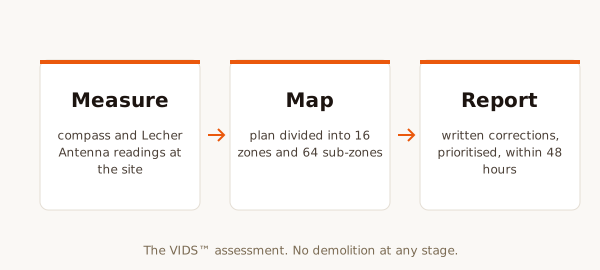
If you are worried about a toilet in your home, a measured reading is the quickest way to know where it actually sits. Book a consultation online or on site in Bangalore and receive a written report within 48 hours.