You can check direction for Vastu yourself with nothing more than a smartphone, a printed floor plan and about twenty careful minutes. Done well, the result is close enough to tell you which zone your entrance, kitchen and bedrooms fall in. Done carelessly, it can be off by 20 degrees or more, which is enough to move a door into a completely different Vastu zone. This guide walks through the method we would like every client to use before an online consultation.
We cover calibration, where to stand, what disturbs a compass, how to take and average readings, the difference between true north and magnetic north, and how to draw north on your plan. At the end we explain when a reading on site is worth having instead.
Why a few degrees matter in Vastu
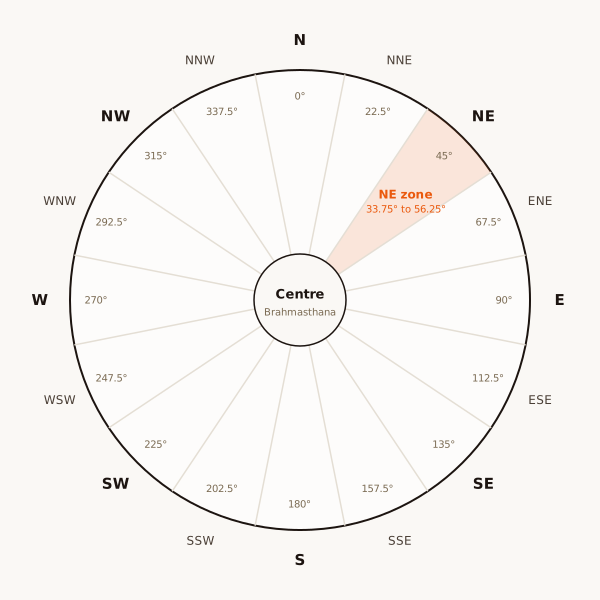
The VIDS™ method divides a property into 16 zones of about 22.5 degrees each, measured from true north. That is much finer than the four main directions of 90 degrees each, so small errors matter.
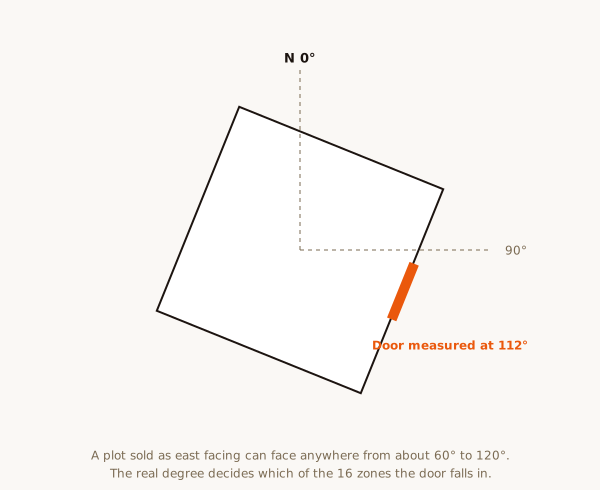
A simple calculation shows why. The East zone runs from about 78.75 to 101.25 degrees. A main door that truly faces 80 degrees sits just inside East. Read it as 76 degrees, a 4-degree error, and it falls in East-North-East instead. Many traditional Vastu recommendations change between those two zones, so precision is worth the effort.
What you need
- A smartphone with a built-in compass sensor. Almost all current phones have one.
- The phone’s own compass app or a reputable compass app that shows degrees.
- A printed floor plan or site plan, a pencil, a ruler and a protractor.
- Optionally, a simple baseplate compass as a cross-check.
- A notebook to record each reading, where you stood and anything metal nearby.
How to check direction for Vastu in 9 steps
- Remove magnetic accessories. Take the phone out of any case with magnets, such as wallet cases or cases made for magnetic car mounts.
- Calibrate. If the app asks, move the phone slowly in a figure-of-eight a few times. Keep location services on so the phone knows where it is.
- Decide true or magnetic. Some phones, including the iPhone Compass app, offer a true north setting. Note which mode you are using, because it affects step 9.
- Choose where to stand. For the facing of a house, stand just outside the main door, on the threshold line, facing outwards. Keep a metre or two away from steel gates, grills, cars and two-wheelers.
- Hold the phone correctly. Hold it flat at waist height, with its top edge pointing straight out from the door, square to the front wall.
- Wait and record. Let the needle settle for a few seconds, then write down the reading in degrees.
- Repeat at other points. Take readings at three to five more places: along the front boundary, at the gate, in the open part of the plot, parallel to the same wall.
- Average the consistent readings. Set aside any reading that is clearly out of line with the rest, and average the others.
- Correct to true north if needed, and mark the plan. Apply the magnetic declination only if your phone was in magnetic mode, then draw north on your plan as described below.
Calibrating and checking your phone
Phone compasses are useful but sensitive. Before trusting yours, check it in a simple way. Stand in an open space, such as a park or an empty road, and compare its reading with a second phone or a baseplate compass. If they agree within a few degrees, you have a usable instrument.
Another good check uses a map. Satellite views in common map apps are drawn with true north at the top. Find a long straight road or boundary wall near your home, note its direction on the map, then stand beside it and compare with your phone. A large mismatch tells you to recalibrate before you check direction for Vastu at the property.
What throws a compass off
A phone compass measures the earth’s magnetic field, which is weak. Anything magnetic or carrying current nearby can swamp it:
- Steel gates, window grills, railings and steel doors.
- Reinforced concrete columns, beams and lift shafts, which contain steel bars.
- Cars, two-wheelers and steel furniture such as cupboards.
- Speakers, magnets, refrigerators and induction cooktops.
- Electrical panels, meter boards, inverter batteries and live wiring in walls.
- Laptops and other phones held close by.
This is why readings taken indoors, especially inside apartments, are often unreliable. Outdoor readings away from metal are much steadier.
Taking several readings and averaging
One reading is never enough for a Vastu decision. Record each point in a small table: where you stood, the reading, and what was nearby.
Good readings usually agree within a few degrees. Suppose you record 82, 84, 83 and 97 degrees. The 97 is clearly out of line, probably caused by a gate or a parked car, so set it aside. The average of the other three is 83 degrees. If your readings spread by more than about 5 degrees with no obvious culprit, move further from metal and start again.
True north and magnetic north
A compass points to magnetic north. The Vastu zones in the VIDS™ method are laid out from true north, the direction of the geographic North Pole. The angle between the two is called magnetic declination. It varies from place to place and changes slowly from year to year, so we do not quote a fixed figure.
To find the current value for your location, use the NOAA magnetic declination calculator. Enter your city or coordinates and the date. The result is given as degrees east or west.
- If declination is east, add it to your magnetic reading to get the true bearing.
- If declination is west, subtract it.
- If your phone was already set to true north, do not apply it again.
Applying the correction twice is one of the most common errors we see.
Drawing north on your floor plan
Once you have a true bearing for the front of the house, transfer it to the plan:
- On the plan, draw a short arrow pointing straight out of the front wall, from the main door. That arrow represents your averaged bearing, for example 83 degrees.
- Bearings are measured clockwise from north, so north lies 83 degrees anticlockwise from that arrow. Place the protractor at the base of the arrow and mark it.
- Draw a clear north arrow and write the bearing beside it, with the date and whether it is true or magnetic.
- For a regular plan, find the centre by drawing the diagonals. Irregular plans need more care, and that is best left to your consultant.
Our guide to the 16 Vastu zones shows how the grid is laid out from that north line.
Apartments, houses and plots
Where you stand depends on the property:
- Apartments: corridors and lobbies are full of steel, so readings there are poor. Take readings at ground level outside the tower, along a wall parallel to your flat, and check the alignment on a satellite map. Schools differ on whether the flat’s main door or its main balcony defines the facing, so we record both. See our apartment buying Vastu checklist.
- Independent houses and villas: read at the main door and at the gate, and along the front boundary.
- Plots: read along each boundary line and from the middle of the plot. Our plot buying checklist and the guide to plot facing direction explain what to do with the result.
Using your reading for a first Vastu check
Once north is on the plan, you can do a simple first pass yourself. Draw lines from the centre of the plan every 22.5 degrees, starting 11.25 degrees either side of north, and label the 16 zones. Then note which zone holds each of these:
- The main door, read from its centre point.
- The kitchen stove, and the sink.
- Each toilet.
- The master bedroom, and where the head of the bed sits.
- Any staircase, overhead tank or borewell.
This gives you the measured layer of a Vastu assessment. What each zone traditionally suits is a separate question, covered in our guides to main door Vastu and kitchen Vastu. Treat your own result as a starting point, not a verdict: a door that sits within a few degrees of a boundary deserves a second, more careful reading before you change anything. Keep the plan, your readings table and photographs together, because they make any later Vastu consultation quicker and more accurate.
Common mistakes when you check direction for Vastu
- Pointing the phone at the door from outside, which reverses the facing by 180 degrees. Always face outwards.
- Reading next to a steel cupboard, fridge or meter board.
- Applying the declination twice.
- Trusting the facing printed in a brochure, which is often rounded.
- Taking a single reading.
- Leaving the phone in a magnetic case.
- On a corner plot, assuming the busier road decides the facing. The main door does.
- Rounding to the nearest of four directions instead of recording degrees.
When to ask for an on-site reading
A careful phone reading is enough for an initial online Vastu consultation, where we work from your readings, your plan and a video walk-through. Our note on how to prepare for a Vastu consultation lists what to send.
Ask for a reading on site when:
- Your readings spread by more than about 5 degrees and you cannot find the cause.
- The main door or a key room sits close to a zone boundary.
- The plot is irregular or has cut corners.
- You are about to buy, or to finalise drawings for a new build.
On a visit we take readings at several points, correct for declination and mark the grid on your plan. The same true-north line also drives our guide to the sun path in Bangalore. Fees for both options are on the consultation fees page, and you can book a consultation whenever you are ready.
What an online Vastu assessment covers
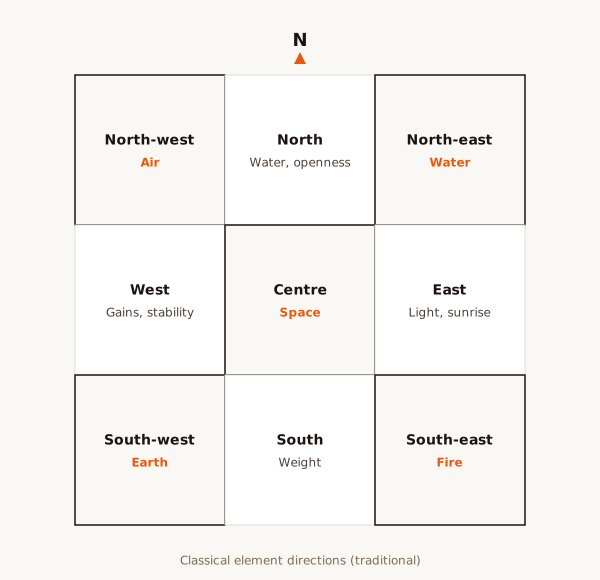
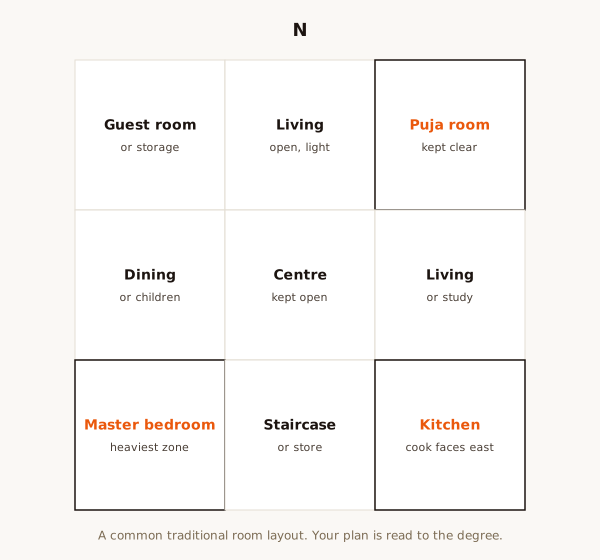
An online assessment uses traditional Vastu analysis only. We draw the 16-zone map from the centre of your plan, using compass readings you take with us on a video call, and lay the 3×3 grid over the same plan: the nine-square division with the Brahmasthan at the centre. Every finding comes from these two methods, such as which zone holds each door, room, kitchen, toilet and water point, and how the nine squares and the centre are used.
Geopathic stress readings with the Lecher Antenna and the Universal Aura Scanner are not part of an online assessment, because they need us physically on site. If your online report suggests a closer look is worthwhile, an on-site visit can follow.