This Vastu for home complete guide brings together everything we look at when we assess a house: the direction of the main entrance, the zone each room sits in, and whether daily activities such as cooking, sleeping and prayer line up with traditional guidance or work against it. It applies to independent houses, villas, row houses and apartments.
Think of it as the starting point. Each section below gives the essentials for one part of the home, and links to a deeper article where there is more to say. Throughout, we separate what the classical Vastu texts recommend from what we actually measure in Bangalore homes, and every correction we suggest is designed to work without demolition.
Vastu for home complete guide: what an assessment looks at
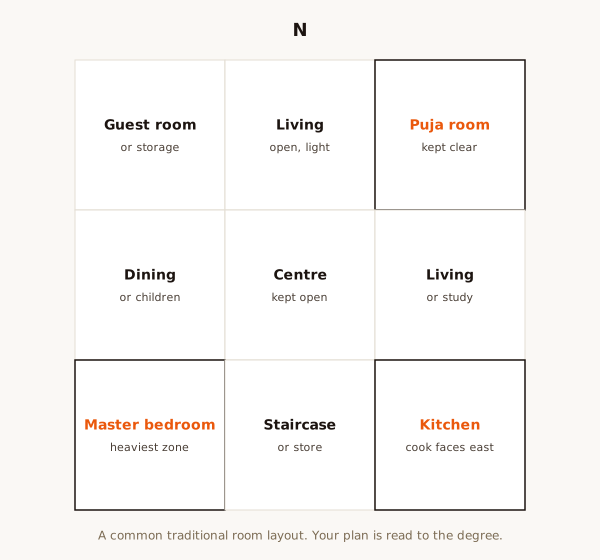
A structured assessment does not treat a house as one undivided space. We map the plot and the built structure against 16 directional zones, the VIDS™ framework, each about 22.5 degrees wide and measured from true north. Then, for every room, we ask three questions:
- Which zone, and which pada within it, does the room fall into?
- What is that zone traditionally associated with?
- Does the way the room is actually used fit that association?
The answers turn a vague sense that something feels wrong into a list of specific, ranked observations. You can read more about the grid itself in our guide to the VIDS 16 zone framework.
The main door and entrance
The entrance is usually assessed first, because its direction affects how the rest of the house is read.
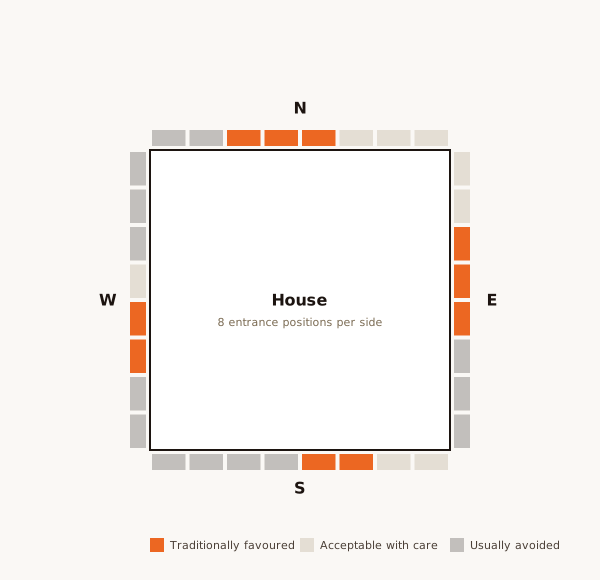
Traditional guidance: a North, East or North-East facing entrance is considered favourable.
What we measure: the exact degree within that direction matters more than the broad compass point, so two East facing homes on the same street can read quite differently.
South and West facing entrances are common in Bangalore layouts and are not a reason to reject a house. They simply call for specific, manageable corrections at the threshold. Our article on Vastu for main door and entrance covers each direction in detail.
The kitchen
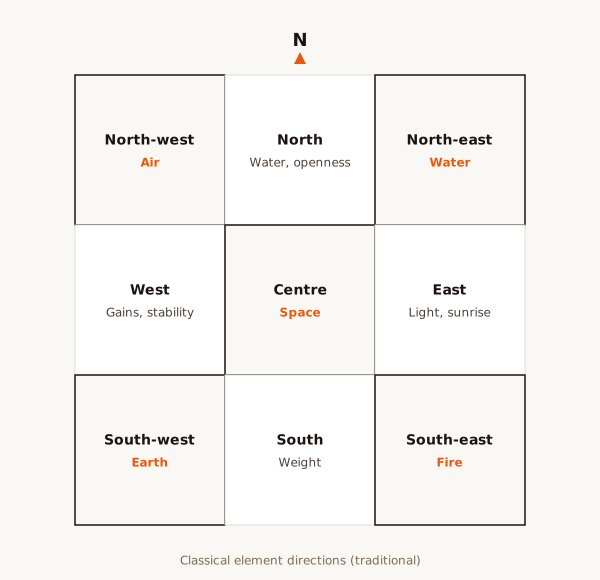
The kitchen is one of the most consistently agreed points across different schools of Vastu. Its fire element makes the South-East the traditional first choice, with the North-West as the usual alternative. The cook ideally faces East while working, and the stove and sink are kept apart rather than side by side.
In apartments especially, kitchens often sit in the North or North-East because of how the building is planned. That is common and rarely calls for relocation. See Vastu for kitchen for placement, stove direction and proportionate corrections.
Bedrooms and the master bedroom
Traditional guidance favours the South-West for the master bedroom, the zone associated with earth, weight and stability. Children and younger family members are often placed in the West or North-West. For sleeping, head towards the South is the most commonly cited recommendation, followed by East, while head towards the North is generally advised against.
Room layouts do not always cooperate, and a bed sometimes has only one sensible position. Our article on Vastu for bedroom explains what to do when the ideal is not possible.
Puja room, living room and study
The puja area is traditionally placed in the North-East, the zone associated with water and clarity, and kept clean, light and uncluttered. In compact flats a wall shelf or a small cabinet in that corner often works well when a separate room is not possible.
Living rooms suit the North, East or North-West, where light and movement are welcome. A study or home office is usually placed so the person working faces North or East. These are traditional preferences rather than rigid rules, and we weigh them against how the family actually uses the space.
Toilets, staircases, water and the centre
Some features carry more weight in a home reading than their size suggests:
- Toilets are best kept out of the North-East and the centre; West, North-West and South-South-West are more traditional positions.
- Staircases are traditionally placed in the South, West or South-West, and are kept away from the centre.
- Underground sumps and borewells are preferred in the North or North-East, overhead tanks in the South-West.
- The centre of the house, the Brahmasthana, is kept open and free of heavy furniture.
When one of these sits in a less favoured zone, it does not mean the house is unsuitable. It means the surrounding zone needs thoughtful handling.
Common issues we see in Bangalore homes
Across apartments and independent houses in the city, a handful of patterns come up again and again. These are general observations, not findings for any particular home:
- Toilets or utility areas in the North-East corner, created by standard apartment floor plates
- Kitchens in the North because the builder grouped plumbing on one side
- Heavy wardrobes and storage in the North-East while the South-West is left empty
- Cluttered central halls used as storage or through-routes
- Extensions added on one side of an older independent house that shift the centre of the plan
Most of these respond well to changes in use, placement, colour and lighting.
Existing homes versus new construction
The assessment differs depending on stage. For a house already built and lived in, the question is which corrections are practical without structural change. Most homes we assess fall into this group. See Vastu for existing property.
For a home still being designed or under construction, there is far more room to align room placement with the zones from the outset, and it costs very little to do so at drawing stage. See Vastu for new construction.
Apartments, villas and independent houses
The same 16 zone approach applies to every type of home, adjusted for the boundary that matters. For an apartment we read the unit itself, not the whole tower. For a villa or independent house we read the plot and the building together, including the compound wall, gate, garden and any outbuildings.
The specifics for each type are covered in Vastu for apartments, Vastu for villas and independent house Vastu.
How a home assessment works
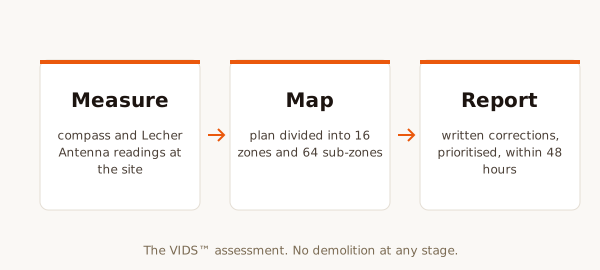
On a site visit in Bangalore, which typically takes two to four hours for a home, we take several compass readings away from metal and electrical interference, locate the true centre of the plan, and correct the readings for magnetic declination using the NOAA magnetic declination calculator. Where possible we also take a Lecher Antenna reading to check sleeping and working spots for geopathic stress.
For homes outside Bangalore or overseas, an online consultation uses your floor plan, compass photographs and a video walk-through. The directional analysis is the same; only the instrument reading is left out. An online assessment uses traditional Vastu only, the 16-zone map and the 3×3 grid drawn on your plan; geopathic stress readings need a site visit.
Corrections without demolition
Every correction we recommend for a home is zero-demolition. In practice that means changing how a room is used, moving beds, desks and storage, choosing colours that suit each zone, improving light in dark corners, and clearing zones that are meant to stay open. We sell no products and take no commission from builders, so nothing in the report exists to sell you something.
If a feature genuinely cannot be balanced without construction, the report says so plainly and lets you decide.
What the written report includes
A Vardhini Vastu home assessment ends in a written report, delivered within 48 hours. It includes the compass-accurate entrance reading, the zone map of the house, room-by-room observations and specific recommendations ranked by priority, so you know what to do first.
You can view a sample Vastu report to see the format, and the methodology page explains each stage of the method.
Light, air and open space
Many classical recommendations line up with practical comfort. The North and East receive gentle morning light in Bangalore, so keeping those sides open, with larger windows and lighter furniture, tends to make a home brighter and cooler. The South and West take the harsher afternoon sun, which is one reason tradition places heavier walls, storage and the master bedroom there.
What we measure: on a visit we note where daylight actually falls, where air moves through the house and which corners stay dark all day. A dark, stuffy North-East corner is one of the most common findings, and it is often fixed simply by moving a cupboard, changing a curtain or adding a light.
This is also why we ask about how each family member uses the home through the day. A room that reads well on paper but is never used, or is used for the wrong activity, is a better place to start than any change to the structure itself.
Getting help with your own home
If you would like this Vastu for home complete guide applied to your own house, our Vastu for home service page explains the consultation, and the fees page lists the costs for apartments, villas and online reviews. When it suits you, you can book a Vastu consultation and we will begin with the entrance.