Quick Answer: Is a South-Facing House Good or Bad as per Vastu?
A south-facing house is not bad as per Vastu. In classical Vastu Shastra, orientation alone never determines whether a home brings peace or difficulty. What determines the energy of a south-facing home is the exact position of the main entrance door along the south wall and the internal room zoning. When the entrance falls in the third pada (S3 Vitatha, 157.5° to 168.75°) or fourth pada (S4 Grihakshata, 168.75° to 180° due south), classical texts consider it highly auspicious. With a heavy south-west, open north-east, and kitchen in the south-east, a south-facing home functions exceptionally well.
South-facing house Vastu is the subject of more worry than any other orientation, and almost all of it is unnecessary. South-facing houses carry an unearned reputation because of oversimplified rules circulating online. When the main door sits in the correct pada and the internal layout is planned according to the 16 zones, a south-facing property can be just as prosperous, peaceful, and comfortable as an east or north-facing home. This guide explains how to measure a south-facing property, the exact degree ranges for favoured entrance doors, mistakes to avoid, a 10-point buyer checklist, and how existing homes are balanced without demolition.
The guidance draws on classical Vastu texts (including the Aparajitaprccha) and on properties measured with the VIDS™ method: degree-accurate compass readings corrected for magnetic declination and mapped into 16 zones from the centre of the house.
Is a south-facing house good or bad as per Vastu?
Many homebuyers in Bangalore hesitate when looking at south-facing plots or flats, and sellers often discount them as a result. The anxiety stems from popular folklore stating that the south is ruled by Yama, the lord of death, leading people to believe that all south-facing homes bring financial ruin or illness. This is an incorrect oversimplification.
Classical Vastu Shastra does not condemn any cardinal direction. Every single direction, whether North, East, South, or West, has a full spectrum of energies ranging from highly positive to challenging. In fact, traditional texts specify that a south entrance in the appropriate pada brings fame, success, and steady stability to its occupants. A south-facing house also has inherent architectural strengths: the south side naturally requires heavier mass, fewer open penetrations, and higher boundary walls, which fits standard roadside security and boundary design. The kitchen also fits effortlessly into the south-east corner at the front.
Facing vs entrance: why property orientation is not the door
The single most important distinction buyers must understand is the difference between property facing and main door position:
- Property facing: This refers to the direction you face when stepping out of the front gate onto the road, or the direction the main facade of the building addresses. A south-facing property simply means the access road sits on the south side.
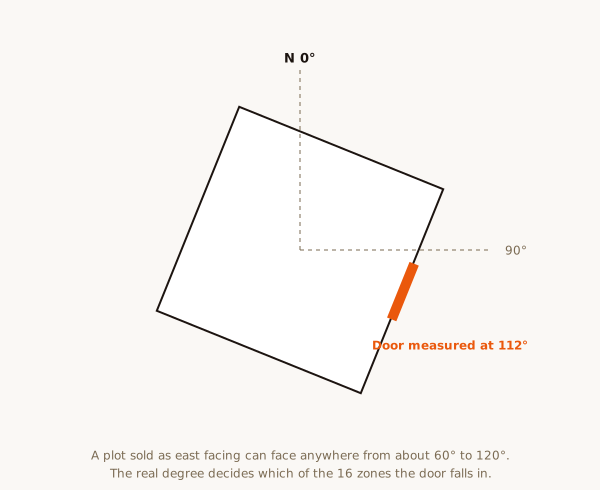
- Main entrance door: This is the exact physical opening through which people enter the built interior. On a south-facing wall, that door can be situated anywhere across eight distinct 11.25-degree sectors (padas). Furthermore, a home on a south-facing plot can have its main door opening towards the East or North through an entrance veranda or foyer.
Judging a home merely by its facing without calculating where the entrance door sits is a mistake. An east-facing house with a door placed in an inauspicious corner pada can be far more disruptive than a south-facing home with a door accurately placed in the auspicious S3 or S4 positions. For a complete guide to entrance mechanics across all four walls, explore our comprehensive 32 entrance in Vastu with degrees chart.
The 180 degree south entrance rule
In angular degree-based Vastu, the true south axis is exactly 180.0° (measured clockwise from true north at 0°). The 16 Vastu zones allocate 22.5° to the primary South zone, which spans from 168.75° to 191.25°.
When we break the perimeter into the 32 padas (each covering 11.25°):
- S3 (Vitatha): 157.5° to 168.75° (East of South). This pada brings power, capability, and prosperity. Highly favoured for residential entrances.
- S4 (Grihakshata): 168.75° to 180.0° (Exact True South segment). This pada brings fame, societal respect, and steady abundance. Highly favoured.
- 180.0° threshold: 180.0° is the exact dividing line. Doors that sit entirely between 157.5° and 180.0° receive the full benefit of S3 and S4.
- S5 (Yama): 180.0° to 191.25° (West of South). Doors crossing past 180° towards the South-West are traditionally avoided as they generate unnecessary tension and financial drag.
When buyers ask about a 180-degree south entrance, our first step is measuring whether the door centre sits on the auspicious east-of-south side (S3/S4) or extends into S5. Even when a door straddles S4 and S5, zero-demolition threshold balancing brings it into complete harmony.
Main door positions in south-facing house Vastu
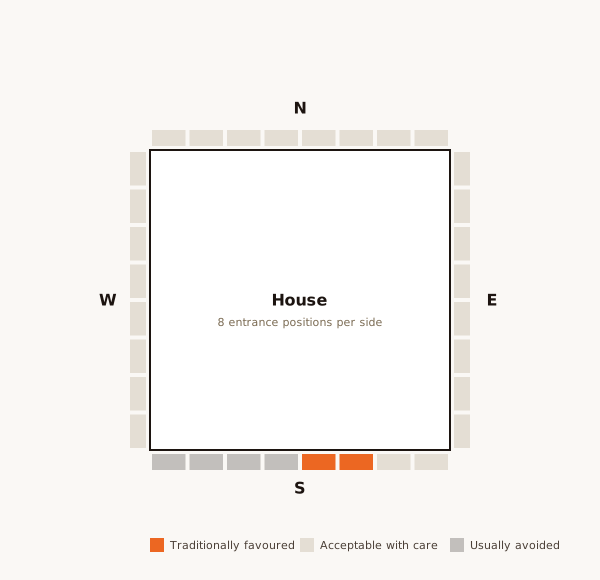
Classical texts divide each side of a building into eight entrance positions (padas). The positions below follow the standard Vastu Purusha Mandala division, confirmed on your measured architectural drawing.
Along the south wall, counted from the south-east corner towards the south-west corner:
- 1st Pada (S1 Anila, 135° to 146.25°): Near the South-East corner. Inauspicious for a main entrance; linked to unexpected expenses.
- 2nd Pada (S2 Pusha, 146.25° to 157.5°): Acceptable in commercial contexts, but creates service obligations in residential homes.
- 3rd Pada (S3 Vitatha, 157.5° to 168.75°): Traditionally favoured. Encourages prosperity and business progress.
- 4th Pada (S4 Grihakshata, 168.75° to 180.0°): Traditionally favoured. Brings name, honour, and family growth.
- 5th to 8th Padas (S5 to S8, 180.0° to 225° towards South-West): Yama, Gandharva, Bhringaraja, and Mriga. Avoided for main entrances because they destabilise domestic harmony and financial retention.
A door falling in the south-west quadrant is the most frequent finding we correct during audits. We balance it using metallic threshold strips, colour resonance, and directional lighting, completely avoiding structural demolition.
10-point pre-purchase checklist for south-facing homes
Before you pay a token deposit or sign an agreement for a south-facing villa, flat, or plot, review these 10 practical checks:
- 1. Exact Entrance Pada: Confirm that the main door opening falls between 157.5° and 180.0° (padas S3 or S4). Avoid doors close to the South-West corner.
- 2. Kitchen Placement: Ensure the kitchen sits in the South-East (Agneya fire zone) with the cook facing East. The North-West is an acceptable secondary choice.
- 3. Master Bedroom: The master bedroom must be situated in the South-West (Nairutya earth zone) to provide stability, authority, and restful sleep.
- 4. North-East Openness: Verify that the North-East (Ishanya zone) is clear, lightweight, and clean. There must be no toilets, septic tanks, or heavy staircases in the North-East.
- 5. Water Sump and Borewell: The underground water sump and borewell must sit in the North, North-East, or East, never in the South-West or South.
- 6. Overhead Water Tank: The overhead water storage tank should be placed on the terrace in the South-West or West, providing grounding weight.
- 7. Staircase Location: The internal or external staircase should be located in the South, West, or South-West, climbing in a clockwise direction.
- 8. Rear Setbacks: On independent plots, ensure the rear setbacks (North and East) are wider and more open than the front setback (South).
- 9. Slope and Drainage: The plot and site drainage should naturally fall towards the North and East, while the South and West remain higher and dry.
- 10. Road Hits (Veedhi Shoola): Check that no perpendicular road runs directly into the South-West or South-East corners of the property.
You can send your floor plan to us on WhatsApp at +91 97391 05574 for a pre-purchase assessment report within 48 hours.
Room layout for a south-facing home
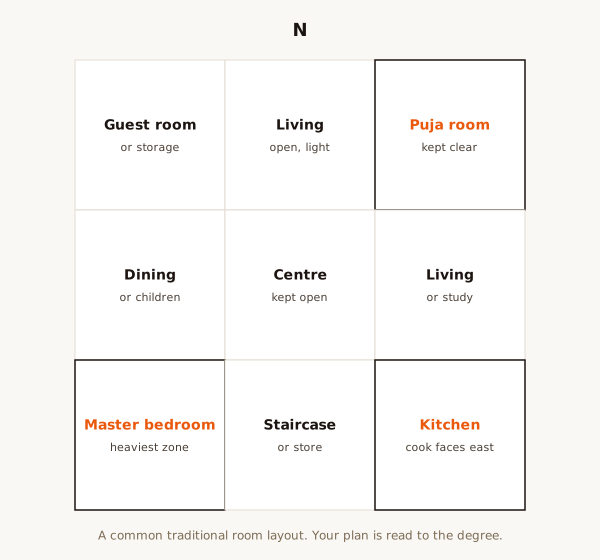
With the road and entrance in the south, an ideal room layout arranges functions as follows:
- Kitchen: South-East (Agneya). Perfectly located at the front of a south-facing house, allowing morning sun and easy ventilation.
- Master Bedroom: South-West (Nairutya). Placed at the rear or side in the heaviest, most stable sector of the home. Bed head positioned towards South or East.
- Living Room and Dining: North or East. Located deeper into the home where the environment is quieter, cooler, and filled with gentle natural light.
- Puja Room: North-East (Ishanya). Dedicated to quiet contemplation and spiritual focus in the clearest zone.
- Children’s Bedroom or Study: West or North-West. Fosters concentration and structured learning routines.
- Staircase and Heavy Storage: South or South-West wall, adding structural grounding to the southern face.
Open space at the back
In a south-facing plot, the North and East boundaries sit at the rear of the house. Vastu principles advise that the North and East should remain lighter, lower, and more open than the South and West. In practice, this means leaving a generous rear garden, utility yard, or wide setback along the northern and eastern walls.
This is practical in everyday living: keeping the back open allows cross-ventilation, keeps the house naturally cooler during hot afternoons, and balances the heavier front parking and driveway areas.
Common mistakes in south-facing homes
During our on-site audits in Bangalore, we frequently observe four critical mistakes in south-facing houses:
- Placing the main entrance in the South-West corner (padas S6 to S8): This is the most common issue. Builders place the gate on one extreme to maximize car parking, inadvertently putting the entrance in the zone of instability.
- Building tight against the North and East boundaries: Pushing the house back to create an oversized front parking porch leaves no setback at the rear, choking light and ventilation from the North-East.
- Placing a toilet or septic tank in the North-East: Locating sanitary plumbing in the sacred water sector creates continuous energetic conflict.
- Installing floor-to-ceiling glass in the South-West: Over-glazing the South-West exposes the master bedroom to extreme afternoon heat and weakens the required solidity of Nairutya.
Every single one of these defects can be corrected or balanced without structural demolition using zero-demolition spatial treatments.
South-facing myths
Myth 1: “South-facing houses always bring misfortune.” Fact: Classical Vastu texts like the Samaranganasutradhara and Aparajitaprccha praise south-facing entrances in Vitatha (S3) and Grihakshata (S4) for bringing rapid career advancement and material security.
Myth 2: “If you have a south-facing entrance, you must break the wall and move it.” Fact: Moving a door is expensive and unnecessary. In 10+ years of practice, we balance unfavourable door padas using metallic boundary dividers, elemental threshold colours, and lighting adjustments.
Myth 3: “South-facing flats are inferior investments.” Fact: Because of irrational market fear, south-facing flats are frequently priced 5% to 10% lower. When the unit has an S3/S4 door and good internal zoning, it offers exceptional value and high appreciation.
South-facing apartments
In high-rise apartment towers, builders often advertise a flat as “south-facing” because the living room balcony looks south. However, in Vastu diagnostics, we read the flat as an independent energetic unit calculated from its own geometric centre.
What matters for daily living in a flat is where your own front door opens into the internal corridor, and which zones hold the kitchen, master bedroom, and bathrooms inside your four walls. A south-facing balcony is actually a benefit in Bangalore winters, providing bright natural warmth without compromising Vastu compliance.
Buying a south-facing plot
You can confidently purchase a south-facing plot provided its shape, road access, and surrounding elevations align with basic natural geometry:
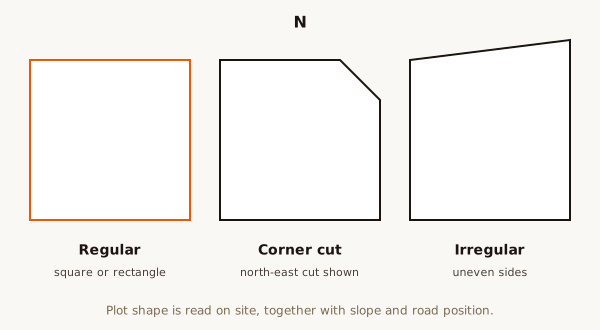
- Plot shape: Square or rectangular (1:1.5 or 1:2 ratio). Avoid irregular trapezoids or sharp cut corners; see our guide to plot shape Vastu.
- Gate location: Ensure the layout allows the compound gate to be positioned in S3 or S4, away from the South-West corner.
- Surrounding levels: The road and neighbouring land on the South and West should ideally be equal to or higher than the land on the North and East.
Kitchens in south-facing homes
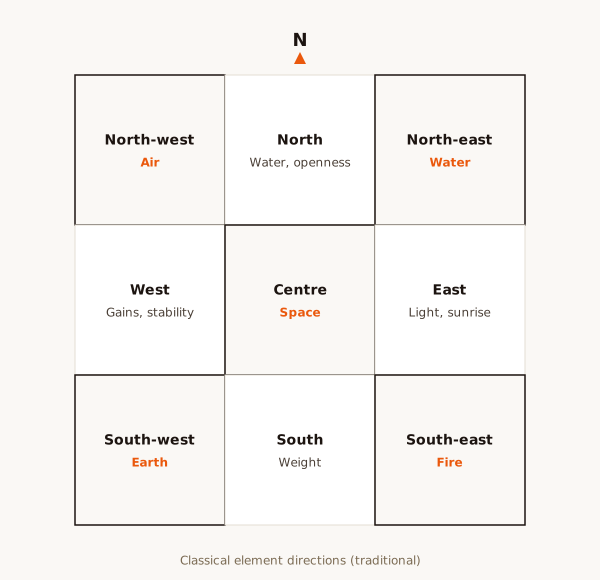
The South-East (Agneya) corner is the natural home of the fire element (Agni). In a south-facing house, this corner sits conveniently at the front right of the property. This allows the kitchen to have direct external ventilation, great morning sunlight, and an ergonomic layout where the cook faces East while preparing meals.
If the South-East is taken by a portico or living space, the North-West (Vayavya air zone) serves as an approved secondary location. The kitchen should never be situated in the North-East or South-West.
Water, sump and overhead tank
Managing water storage correctly is vital in south-facing homes:
- Underground Sump and Borewell: Must be positioned in the North, North-East, or East sector in the rear or side setback. Digging a sump in the South or South-West creates major elemental disturbance.
- Overhead Water Tank: Must be installed in the South-West or West on the rooftop terrace. Its heavy physical load adds grounding weight to the Nairutya zone, which directly supports the health and financial stability of the family.
Gates and compound walls
On the south boundary wall, place the driveway and pedestrian gate in the S3 (Vitatha) or S4 (Grihakshata) padas. The south compound wall should be built slightly thicker and higher than the north and east boundary walls. This provides thermal shading from harsh afternoon sun and maintains the traditional heavy-south, light-north elevation balance.
Corrections without demolition
If you currently live in a south-facing home with an imperfect entrance or misplaced room, you do not need to demolish walls, break door frames, or buy costly religious talismans. We do not sell greed and fear.
Our non-structural corrections utilize scientific spatial balancing:
- Threshold energy balancing: Brass or copper metallic strips embedded along the doorway threshold to isolate negative angular zones.
- Elemental colour therapy: Using warm tones, greens, or earth hues on specific walls to counterbalance elemental clashes.
- Lighting and reflector alignment: High-lux warm illumination at the entrance foyer to dispel shadowed entries.
- Room repurposing: Swapping the functional use of rooms (such as shifting a study to the west and guest room to northwest).
For more examples, see our detailed guide on zero-demolition Vastu corrections.
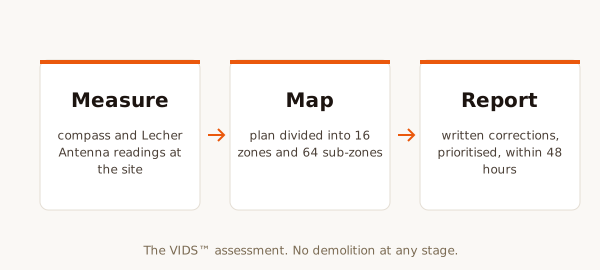
How we assess a south-facing house
During an on-site consultation in Bangalore, Raghavendra Hebbur personally conducts:
- Precise compass triangulation across multiple points, corrected for Bangalore’s magnetic declination.
- Floor plan gridding into 16 zones and 32 padas from the true geometric centre (Brahmasthan).
- Geopathic stress audit using the Lecher Antenna and Universal Aura Scanner to detect underground earth radiation lines.
- Comprehensive written diagnostic report delivered within 48 hours containing prioritized, zero-demolition solutions.
For homes outside Bangalore, our online Vastu consultation provides the full 16-zone directional analysis remotely from your floor plan.
Living room and entrance foyer
In a south-facing layout, entering directly into a cavernous living room can expose the interior to heavy heat and street dust. Creating an entrance foyer or vestibule immediately inside the south door filters street noise and allows the interior living space to expand naturally towards the cooler North or East sides of the floor plate. Keep the entrance foyer brightly lit and free of shoe rack clutter.
Car parking and the front setback
The front setback of a south-facing house naturally accommodates covered car parking. Because vehicles and car porches represent physical weight, placing them along the southern boundary wall aligns perfectly with Vastu’s requirement for a heavy South and lightweight North. Ensure the car porch roof does not slope towards the South; it should slope towards the North or East.
Fees and pre-purchase plan evaluation
Our pricing is completely transparent with no hidden costs and zero product-selling agendas:
- Pre-purchase plot or flat check: ₹10,000 (online worldwide or on-site in Bangalore; written report in 48 hours).
- Bangalore apartment or row house on-site: ₹15,000.
- Bangalore villa or independent house on-site: ₹25,000.
- Online consultation (existing home): ₹5,000 worldwide.
View our complete fee structure on the Vastu consultation fees page.
Next step
If you are considering a south-facing flat, villa, or plot, do not rely on generic opinions. Send the floor plan and Google Maps pin to us on WhatsApp at +91 97391 05574 before paying your booking amount. We will verify the true-north bearing, calculate the exact entrance pada, and deliver a clear, written verdict within 48 hours.
Frequently asked questions.
Is a south-facing house good or bad as per Vastu?
A south-facing house is not bad as per Vastu. In classical Vastu Shastra, orientation alone never determines whether a property is good or bad. What matters is the exact entrance pada along the south wall (S3 Vitatha and S4 Grihakshata are favoured) and proper internal zoning.
Where should the main door be in a south-facing house?
Along the south wall, the third pada (S3 Vitatha, 157.5° to 168.75°) and fourth pada (S4 Grihakshata, 168.75° to 180° due south), counted clockwise from the south-east corner, are traditionally favoured.
What is the 180 degree south entrance in Vastu?
180 degrees true south marks the exact boundary between pada S4 (Grihakshata) and pada S5 (Yama). In Vastu, an entrance spanning S3 and S4 (157.5° to 180°) is auspicious, whereas doors crossing past 180° towards the south-west (S5 to S8) are avoided.
Can I buy a south-facing flat or independent house?
Yes. South-facing properties often provide excellent light, cooler rear rooms, and natural placement for the kitchen in the south-east. Always verify the entrance pada and room layout before paying the booking amount.
How do you correct a south-facing door without demolition?
With threshold energy alignment, elemental colour balancing, lighting correction, and pathway adjustments chosen for the exact degree. No walls need to be broken.
Have a property here you want assessed?
Share the property type and a floor plan on WhatsApp for an exact quote and the next available date.