This Vastu glossary explains the Sanskrit and technical terms you will meet in our reports, in classical texts and in conversations with builders and family. Many of these words are used loosely, and the same term can mean different things depending on who is speaking. Here each one is given a plain definition, with a note where tradition and measurement need to be kept apart.
The terms are grouped by theme: directions and zones, the planning grid, the five elements, rooms and building parts, the plot, measurement and instruments, and corrections. Links lead to fuller guides where a term deserves more than a line.
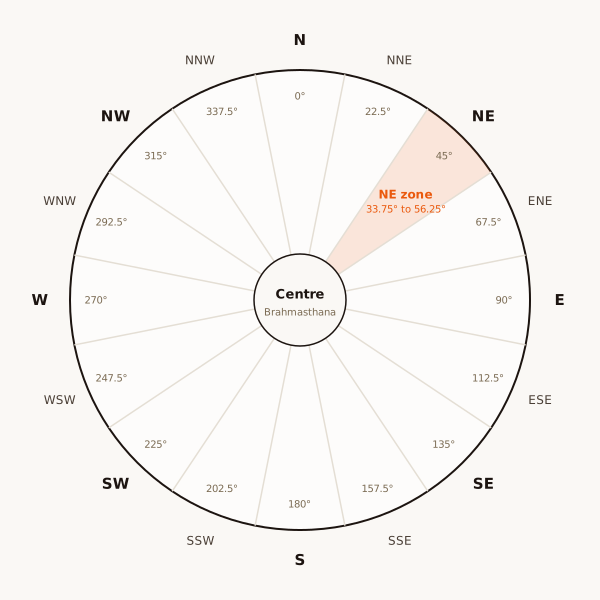
Directions and zones
- Uttara: north.
- Purva: east.
- Dakshina: south.
- Paschima: west.
- Ishanya: north-east, the lightest and most open corner in tradition.
- Agneya: south-east, the corner of fire.
- Nairutya: south-west, the corner of weight and stability.
- Vayavya: north-west, the corner of air and movement.
- Zone: one of 16 segments of 22.5 degrees each, measured from true north from the centre of a building. See the 16 zones.
- Facing: the direction a building or plot faces, usually the side with the main road or entrance. See the eight directions.
The planning grid
- Vastu Purusha: the figure in the traditional story who lies over every site, head to the north-east and feet to the south-west.
- Mandala: the square grid laid over a site. See Vastu Purusha Mandala.
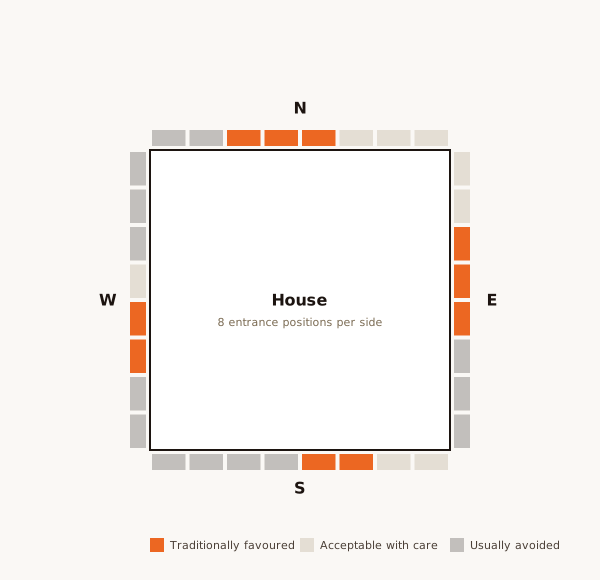
- Pada: one cell of the grid. Each wall has eight padas, which give the 32 entrance positions. See 32 entrances.
- Manduka: the 8×8 grid of 64 padas.
- Paramasayika: the 9×9 grid of 81 padas, common for houses.
- Devata: the presiding deity assigned to a pada.
- Brahmasthan: the central part of the grid, kept open. See Brahmasthan.
- Marma: a sensitive point where grid lines and diagonals cross, traditionally kept free of columns.
- 3×3 grid: a simple nine-part division of a plan that we use with the 16 zones, especially for online assessments.
The five elements
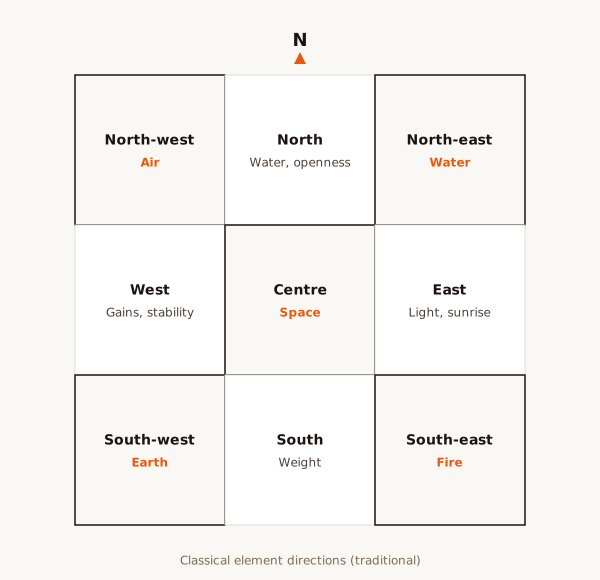
- Pancha mahabhuta: the five great elements of classical thought.
- Prithvi: earth, associated with the south-west.
- Jala: water, associated with the north-east.
- Agni: fire, associated with the south-east.
- Vayu: air, associated with the north-west.
- Akasha: space, associated with the centre.
See the five elements for how each is read in a home.
Rooms and building parts
- Griha: a house or home.
- Dwara: a door or entrance.
- Devagriha or pooja room: the prayer room, traditionally in the north-east.
- Mahanasa or pakashala: the kitchen, traditionally in the south-east.
- Shayanagriha: the bedroom, the master bedroom traditionally in the south-west.
- Sopana: the staircase, traditionally in the south, west or south-west.
- Angana: the open courtyard, often at the centre in older homes.
- Sump: underground water storage, traditionally in the north-east.
- Overhead tank: roof water storage, traditionally in the south-west.
The plot and its surroundings
- Bhumi: land, the plot.
- Gaumukhi: a plot narrower at the front than at the back, traditionally good for homes.
- Sherdaha or simhamukhi: a plot wider at the front, traditionally preferred for commercial use.
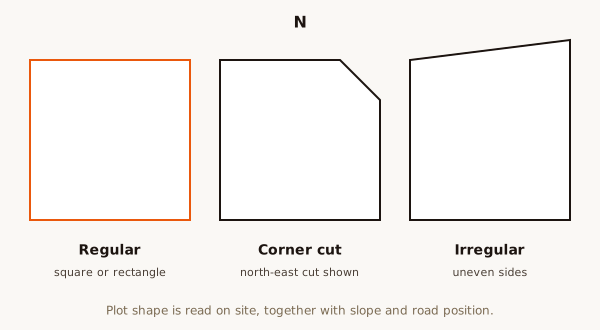
- Cut: a missing corner of a plot or building. See cut corners.
- Extension: a corner that juts out beyond the regular outline.
- Veedhi shoola: a road that runs straight into a plot boundary. See veedhi shoola.
- Slope: the fall of the land, preferred towards the north and east.
- Setback: the open margin between a building and its boundary, set by local rules.
Measurement and instruments
- True north: the direction of the geographic North Pole, the reference for every reading.
- Magnetic north: where a compass points, which differs from true north.
- Declination: the angle between true and magnetic north at a place, looked up with the NOAA magnetic declination calculator.
- Tilt: how far a plot or building is turned from the cardinal directions.
- Shanku: the gnomon, a vertical rod whose shadow was used in the texts to fix east and west.
- Sutra: the measuring cord of the traditional builder.
- Sthapati: the master builder for whom the classical texts were written.
- VIDS™: Vastu Integrated Diagnosis System, our method of reading a property by measured zones.
Geopathic terms
- Geopathic stress: a term used in radiesthesia for supposed disturbances from the ground, such as underground water or faults. It is not accepted by mainstream science, and we describe it that way.
- Radiesthesia: the practice of detecting such influences with hand-held instruments. It is not recognised by mainstream science.
- Lecher Antenna: a radiesthesia instrument we use on site only. See Lecher Antenna.
- Universal Aura Scanner: a dowsing-style instrument used on site only, never online.
See our geopathic stress audit for how these readings are offered and how honestly we frame them.
Corrections and reports
- Dosha: a departure from traditional guidance in a layout. We avoid fearful language and simply describe what does not match.
- Correction: a change that brings a layout closer to tradition, such as room use, placement, colour or light.
- Zero demolition: our approach of correcting layouts without breaking walls. See zero-demolition corrections.
- Measured, traditional, interpretive: the three labels we use in reports to separate what we measured from what tradition says and from claims about outcomes.
The tradition and its texts
- Vastu: a dwelling, or the ground on which it stands.
- Vastu Shastra: the body of knowledge about planning buildings by direction and proportion. See what is Vastu Shastra.
- Vastu Vidya: the knowledge or practice of Vastu, often used for the craft as taught.
- Shilpa Shastra: the wider body of texts on the arts and crafts, including sculpture and building.
- Mayamata: a classical South Indian treatise on architecture and Vastu.
- Manasara: a classical treatise on architecture, proportion and town planning.
- Samarangana Sutradhara: a classical treatise on architecture and machines.
- Aparajitaprccha: a classical text on architecture from western India, which Raghavendra Hebbur is translating.
- Vishvakarma: the divine architect of Indian tradition, to whom much Vastu knowledge is attributed.
Vastu terms you will meet in builder brochures
Property marketing uses Vastu language freely, and not always precisely. A few phrases are worth reading carefully:
- Vastu compliant: there is no official standard behind this phrase. Ask which rules were followed and check the plan yourself.
- East facing or north facing: usually refers to the entrance or the road, not the whole flat. The entrance pada matters more.
- Vastu friendly layout: often means the kitchen is in the south-east. Check the toilets, the master bedroom and the centre as well.
- Corner flat: a flat with two outside walls, which affects light and the reading of cut or extended corners.
Our apartment buying checklist shows how to check these claims against a measured plan.
Reading a Vastu report
Our written reports use these terms consistently. Each room is listed with its zone and degree range from true north, followed by the traditional guidance for that room in that zone, and then any correction we suggest. Items are labelled as measured, traditional or interpretive so that you can see what each statement rests on.
If you would like to see the format before booking, look at our sample Vastu report. The Vastu glossary on this page is meant to sit alongside it, so that no term in your report is left unexplained.
Commercial and industrial terms
- Cash counter: in shops and offices, traditionally placed so that the person handling cash faces north or east.
- Owner cabin: the seat of the owner or director, traditionally in the south-west of an office. See cabin seating.
- Raw material store: in a factory, heavy stock traditionally kept in the south-west.
- Dispatch: finished goods leaving a factory, traditionally from the north-west, the zone of movement.
- Boiler and transformer: fire and power equipment, traditionally in the south-east.
- Effluent treatment: waste water handling, kept away from the north-east.
See the industrial guide and the office guide for how these are read in practice.
Words we avoid
Some words are common in popular Vastu talk but we avoid them because they cause needless fear or promise too much. We do not call a home cursed, unlucky or doomed. We do not say a correction will bring money, marriage, health or a job. We describe what a layout is, what tradition says about it, and what can reasonably be changed.
If you have been told something alarming about your home, a calm measured reading is usually the quickest way to see what is actually there.
Your next step
If a term in your report or in a conversation is still unclear, ask us. We add new entries to this Vastu glossary when clients ask about words we have not yet covered, so the list grows with the questions we hear. For the wider picture, start with Vastu for home. To have your home read and explained in these terms, book a consultation and receive a measured, written report within 48 hours.